

National Grid trialled Scrapp®'s Separation Station technology at their UK headquarters to tackle persistent recycling contamination. The pilot replaced manual waste surveys with a real-time digital system that showed employees exactly how to sort waste at the point of disposal — cutting guesswork, driving correct recycling behaviour, and giving the sustainability team data they'd never had before.
Why office recycling programs fail
Most office recycling programs look fine on the surface. There are bins. There are signs. There might even be a poster in the kitchen explaining what goes where. But the contamination rates tell a different story.
The problem is behavioural, not infrastructural. Employees bring habits from home — and home recycling rules rarely match workplace recycling rules. A coffee cup that goes in the recycling bin at home might need to go in general waste at work. A plastic container that's accepted by a residential curbside program might not be accepted by the commercial waste contract covering the office. The rules are different, but nobody tells the employee that.
This was exactly the challenge facing Joe O'Loghlen, Energy and Sustainability Manager at National Grid. Despite having recycling infrastructure in place at the UK headquarters, the office was struggling with persistent contamination and low-quality recycling streams. The COVID-19 pandemic made it worse — after months of working from home, employees returned with deeply embedded household recycling habits that didn't translate to the workplace.
As Joe put it, the core issue was that colleagues assumed items they could recycle at home could also be recycled in the office. That assumption was wrong more often than it was right — and it was undermining National Grid's recycling targets.
The sustainability team knew the problem existed. But quantifying it was a different challenge entirely. The only way to understand what was in the waste stream was to conduct manual trash surveys — whole teams spending hours physically hand-counting and sorting rubbish to gather data. It was time-consuming, inconsistent, and gave the team a snapshot at best, not a continuous picture.
National Grid needed a way to change behaviour at the point of disposal, not after the fact — and a system that could provide ongoing data without the manual burden of traditional waste audits.
How Scrapp's Separation Station changed the game
Scrapp designed and deployed its Separation Station technology at National Grid's UK headquarters. The Separation Station sat alongside existing bin infrastructure, acting as an interactive guide that told employees exactly how to dispose of each item based on the specific recycling rules for that workplace.
The system works similarly to the Scrapp mobile app, but with features built specifically for shared workplace environments:
- Barcode scanning — employees walk up to the station and scan any packaged item to see the correct disposal route for that office
- Recycling wiki — for everyday items without barcodes (coffee cups, food waste, takeaway packaging, napkins), a tap-to-select interface gives an instant answer
- Community goals and challenges — teams set collective recycling targets, with leaderboards that turn correct disposal into a shared effort rather than an individual burden
- Gamification mechanics — recycling milestones can be tied to charitable contributions or team rewards, making participation tangible and visible
Behind the station, a web dashboard gave the sustainability team real-time visibility into what was being recycled and what was being contaminated — without anyone needing to hand-sort a single bin bag. The dashboard also generated CSR reporting data automatically, including total landfill diversion and CO2e savings — figures that previously required significant manual effort to estimate.
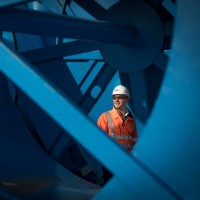
We are able to engage with colleagues and drive the correct behaviours, therefore enabling us to reach our recycling goals.
Joe O'Loghlen
What changed at National Grid's UK HQ
The shift from manual waste surveys to Scrapp's digital system transformed how the sustainability team operated during the trial:
- Manual trash surveys were eliminated — the data that previously required whole teams spending hours hand-counting rubbish arrived automatically through the Separation Station
- Real-time visibility replaced periodic snapshots — instead of surveying the waste stream once a quarter, the team had a continuous picture of what was happening
- Employee behaviour shifted at the point of disposal — rather than relying on posters and emails to educate, the Separation Station provided the correct answer at the exact moment someone was standing at the bin
- CSR reporting data became automated — landfill diversion and CO2e savings were generated directly from the system, reducing the manual effort required for sustainability reporting
For Joe and the sustainability team, the biggest win was moving from reactive to proactive. Instead of discovering contamination problems weeks or months after they happened, the data showed issues in real time — making it possible to address them before they became embedded habits.
Why at-source separation matters more than most businesses realise
The business case for improving office recycling extends well beyond environmental credentials. Commercial waste contracts are priced on the assumption that general waste and recycling streams are separate and uncontaminated. When recycling bins are contaminated — which happens consistently in offices without clear, point-of-disposal guidance — the entire load can be reclassified as general waste. The business pays landfill rates for material that should have been recycled at a fraction of the cost.
Research consistently shows that at-source separation is the most effective way to improve the quality of recycled material and reduce contamination. But for businesses, implementing at-source separation has historically meant investing in training programs, printed guides, and periodic audits — all of which are expensive, time-limited, and hard to sustain.
Scrapp's Separation Station solves this by embedding the education into the disposal moment itself. The employee doesn't need to remember what they learned in a training session three months ago. They scan, they see the answer, they sort correctly. Over time, the repeated interaction builds the correct habit — and the data shows whether it's working.
The environmental case for getting office waste right
Office waste might seem small compared to manufacturing or logistics, but the scale adds up quickly. A typical office worker generates around 200kg of waste per year. Multiply that across a headquarters the size of National Grid's and the total waste footprint is substantial — and so is the opportunity to divert material from landfill.
The environmental impact compounds in two ways. First, correctly sorted recycling streams are actually recycled — they don't get rejected at the MRF and rerouted to landfill. Second, the behavioural change doesn't stay at the office. Employees who learn to sort correctly at work carry those habits home, creating a ripple effect that extends beyond the workplace.
This is why gamification plays a role in the Scrapp system. Community goals, leaderboards, and team challenges create social accountability — recycling becomes a visible, shared commitment rather than a quiet individual action. When a team hits a milestone and triggers a charitable contribution, it reinforces the behaviour and makes it part of the workplace culture.
National Grid's UK HQ trial demonstrated that digital, point-of-disposal guidance can shift employee recycling behaviour in a way that posters, emails, and training sessions alone cannot. The data is immediate, the answers are accurate, and the system doesn't rely on anyone remembering what they were told last quarter.
Ready to fix your workplace recycling program?
If you're a business with recycling infrastructure that isn't delivering the results you expected — or you're still relying on manual waste surveys to understand what's in your bins — book a 15-minute call with the Scrapp team.
See how other organisations are using Scrapp to cut waste costs and improve recycling outcomes: Custom Machine | Re3 | Oddisea