

An exhibition about the working coast, measured to the ounce in Boston's Seaport
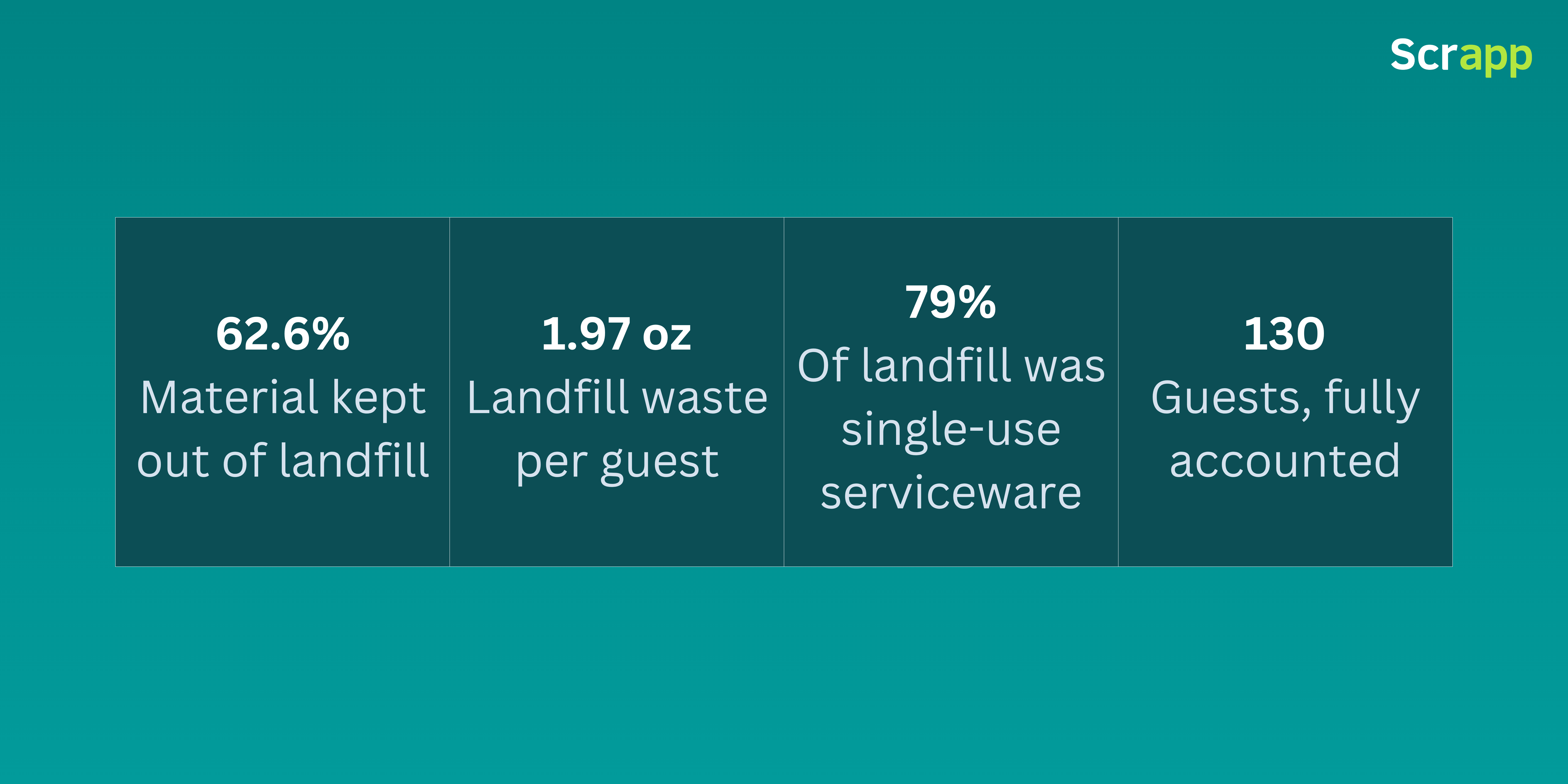
Summary. On August 28, 2026, Contemporary Climate Gallery opened Working Coast — Below the Line to 130 guests at the FPAC Art Space in Boston's Seaport. The exhibition asks what the material traces of craft and labor reveal about a working coastline. CCG and Scrapp decided the opening should be held to the same standard as the work on the walls, so the reception was run as a zero-waste event and measured to find out whether it actually was one and where the waste came from. Every can, bottle, cup, plate, spoon and napkin that moved through the room was counted at the point of service and weighed on site. The result is a complete, census-level material account of a single art opening: 42.78 pounds of material, 62.6% of it kept out of landfill, and just under two ounces of landfill waste per guest. What the other 37.4% was made of is the more useful half of the story, because almost none of it was decided on the night. Scrapp matched the 16 pounds that did reach landfill gram for gram through Plastic Bank.
The question that started it all
Contemporary Climate Gallery is an online-based non-profit, “a contemporary art community outside four blank walls.” It has no permanent building, which is the point: CCG brings emerging artists and audiences together through experiences in locally relevant places. Working Coast — Below the Line, featuring H.Wolfe, Nikki Ekström, and John Mendizabal, examines the tools, hands, and traditions that define life at the water's edge.
The venue madethe theme literal. FPAC Art Space sits in Fort Point, in Boston's Seaport, a working industrial waterfront whose vacated warehouses became quarters for hundreds of artists, more than 250 of whom are still there today. An exhibition about the labor of a working coast, hung in a creative district built exactly by that.
CCG and Scrapp arrived at the same thought at the same time. If the show was going to explore the material evidence people leave behind, the opening itself should be held to that standard. Art imitates life, after all. So the two organizations agreed to run the reception as a zero-waste event and to measure whether it actually was one. That second half is the part almost nobody does.
At this scale nobody measures. Small cultural events assert sustainability all the time, and almost never produce a number, because 130 people generate too little material to interest a waste consultant and far too much to eyeball.
CCG was also working without the things that make this easy. No sustainable procurement policy to lean on, and no say in what its three vendors would carry through the door. This was a first zero-waste exercise for a small organization putting on a one-night event, and the question was never whether it would come out perfect.
How Scrapp characterized a reception in real time
The work broke into three parts.
1. Designed stream separation inside someone else's venue
Scrapp specified the bin architecture, stream definitions and staffing for the reception, then fitted that design around the venue's existing operations rather than replacing them. The priority was set deliberately: capture the heavy, high-value, easily-contaminated streams first. Glass and cardboard were sequestered completely. Cans were separated where the floor plan allowed.
2. Counted at the point of service, not in the bin at the end
Rather than sorting bags after the guests left, Scrapp ran a staffed material-counting station through the reception. Scrapp's co-founder and Chief SustainabilityOfficer worked the station in person, recording items as they moved and weighing specimen units on site to gram precision: 168 bar pours, 240 taco plates, 100 ice cream servings with cup, spoon and napkin, 90 lemonades, 50cans and 21 wine bottles.
Specimen weighing is unglamorous and it is where the accuracy comes from. A 222 ml can weighed 12.98 grams. The paperboard carriers came in at 59.94 and 64.91 grams depending on the pack. A bartender cup was 7.27 grams, a taco plate 7.56 grams, an ice cream spoon 3.43 grams, a napkin 1.31 grams. Multiply each by a count nobody had to guess at and the material accounts for itself.
This distinction matters more than it sounds. A post-event bin dig produces a sample and an estimate.Counting at the point of service produces a census: every item, with a known count and a measured unit weight. It is slower on the night and considerably more useful afterwards, and it is why these figures are measured rather than modeled.
3. Weighed, reconciled, and disclosed the uncertainty
At close, each sequestered stream was weighed. The two methods were then run against each other: item counts multiplied by measured unit weights, checked against the bulk weights. The item build-up inside the landfill stream came to 13.78 lb against a measured 16.0 lb, leaving 2.22 lb unaccounted. That gap is the bottled water. All 96 bottles supplied were consumed, and once their packaging is counted the landfill stream reconciles completely, at an implied 9.55 grams per bottle and cap. That figure was solved from the balance rather than weighed on the night, but it lands inside the 9 to 10 grams a 237 ml PET bottle of that format actually weighs. Two independent methods closing to zero is the strongest confirmation available that the count and the scale agree.
The Numbers Behind The Materials
Every pound of material that passed through the reception, by destination.
What the data showed
At a catered reception, the waste is the serviceware, not the food
Cups, plates, spoons and napkins made up 12.71 of the 16.0 lb sent to landfill: 79.5% of the landfill stream, and close to 30% of everything generated.
These arecounts of items issued at service, so the figure is an upper bound on what wasdiscarded. The item build-up and the bulk weight reconcile completely, whichleaves little room for it to be far off.
The serviceware that decides most of an event's landfill footprint gets chosen weeks earlier, by vendors, for a room they have not seen. What comes onsite sets the ceiling on how well any diversion program can perform.
Certified compostable is not the same as composted
The taco plates were certified compostable. There were 240 of them, weighing 4.00 lb, 25.0% of everything sent to landfill, and all of it was landfilled because FPAC has no organics collection. The napkins, another 0.29 lb, went the same way.
The plates came from a food vendor working a venue it had not worked before. CCG had no say in what the vendors carried in, and no control over the building's waste logistics. FPAC is a gallery, not a facility with an organics contract. Every choice was reasonable on its own, and the chain still put four pounds of compostable material into a landfill, because nothing in it checks what the receiving venue can collect.
Food waste was effectively zero
No food-waste stream was generated. All three vendors sold out and the food and ice cream were fully consumed, and the landfill mass balance leaves almost no room for food waste inside it. That is an operational observation rather than a weighed stream. It is also unusual at a catered event: the source of waste most people expect did not occur, because CCG and its vendors got the quantities right.
Layout, not intent, capped the can recovery
Fifteen of 50 aluminum cans were recovered. All the glass and all the cardboard came back; the cans did not, because bin placement in a borrowed room let guests and staff commingle trash and recycling before either reached a sorted stream. In a space you do not control, separation is bounded by the floor plan.
The glass is why the number starts with a six
Twenty-one wine bottles weighed 25 pounds: 58% of everything that came through the room and 93%of everything kept out of landfill. Glass arrived in a format with an end market and a hauler that takes it, and all of it was captured. The serviceware arrived compostable into a building with no organics stream, and none of it was.
For a first zero-waste exercise, in a venue nobody controlled and with no procurement policy behind it, 62.6% is a real result. It happened because one heavy stream had somewhere to go and the program caught all of it.
Why this matters beyond one gallery
The reception's figures scale linearly. Held against the event sizes most operators actually run, the same food and drinks mix looks like this.
Two lines in that table are worth pulling out.
Massachusetts puts a five cent deposit on carbonated soft drinks, beer, malt beverages and sparkling water. All 50 of the reception's cans qualified. None of its 96still-water bottles or 21 wine bottles did. At 130 guests that is $2.50 and easy to ignore. At 100,000 it is 38,462 eligible cans worth $1,923 in redeemable deposits, sitting alongside 90,000 containers the deposit system does not reach at all.
The compostable plates scale the same way. At 100,000 guests the same specification puts 1.5tons of certified compostable serviceware into landfill. That is a purchase order, not a sorting failure, and it is decided before anyone walks into the room.
The pattern holds whatever the size. Guest behavior is what organizers signpost and staff, and it matters, but it only ever operates on material somebody else already chose.
A counting station needs no stadium-scale technology and no consultant's budget: someone on site with a scale, a list, and the discipline to write down what they see. It worked at 130 guests and runs the same at 3,000. The venues that need it most are the ones priced out of it, working in borrowed rooms with no hauling contract of their own.
Why it mattered to CCG
Working Coast — Below the Line is an exhibition about material traces, about what the objects of a working coastline reveal about the labor and the communities behind them. A reception for that show which left its own material trace suncounted would have been a quiet contradiction, and the kind that visitors notice.
What CCG has instead is a complete account of the evening: what came in, what went out, where it went, what it weighed, and which parts did not work. For an organization with climate in its name and no building of its own, that account is worth more than a higher percentage would have been. It is evidence in a category where almost everyone else has only intent.
● A defensible, census-level number CCG can publish and stand behind: 62.6% diversion, with the uncertainty stated.
● A specific, actionable list of what to change next time, ranked by how much material it moves.
● A clear read on which decisions are actually CCG's to make, and which belong to a vendor or a venue.
Making the event waste neutral
The reception generated 42.78 pounds of material and kept 26.78 of it out of landfill. The 16pounds that were left, 7.26 kilograms, is the part Scrapp matched gram for gram through Plastic Bank: an equal weight of ocean-bound plastic funded for collection in coastal communities before it can reach the sea.
That is a balance rather than an erasure, and this case study counts both sides of it.The 16 pounds still went to landfill. Set against them is the same weight of plastic intercepted somewhere it would otherwise have done harm. Material the event recovered is not offset, because it was not wasted; only the part that was gets matched. That pairing is what CCG and Scrapp mean by a waste-neutral event.
For an exhibition built on maritime material, an offset aimed at marine-bound plastic is about as close to a thematic match as an offset gets.

“Scrapp added an entire new dimension to our project, letting us translate our ‘maritime-material’ exhibition theme into real world impact by preventing an equivalent weight of plastic from reaching the ocean to make the event waste neutral. Working with Mikey, Evan, and the team gave us the framework for understanding our waste impact and savings opportunities to apply for future projects. We look forward to continuing our partnership with Scrapp!”
James LaMarca
What would move the number
Because every item was counted, the same data that produced the 62.6% also shows what the next few points are worth. Three changes account for almost all of it, and none of them needs new technology or a bigger budget. Each figure below is modeled on this event's own measured material.
Run all three and the evening's landfill total falls from 16 lb to 2.09 lb, which is a quarter of an ounce per guest instead of just under two ounces. What would be left is ice cream cups, plastic spoons, and the shrink wrap off the water pallets. Those numbers assume each change lands fully, so treat 94.2% as a ceiling rather than a forecast. The point is where the ceiling sits: two of the three changes are purchase orders and the third is a floor plan.
The same three changes scale. At a 100,000-guest event of this shape, reusable glassware alone stops about 2.5 tons of material from ever being generated, and the full set takes landfill from 6.2 tons to under one ton. The deposit-eligible cans in that scenario are worth $1,923 to whoever redeems them.
About Scrapp
Scrapp is a zero-waste platform for venues, brands and operators who want to know, actually know, where their waste goes, what it costs them, and what it could earn them.We unify fragmented hauler and procurement data into a single operational truth, surface the invisible costs hiding in line items, and build the playbook that converts insight into measurable savings, recovered revenue and material kept out of landfill. TRUE Zero Waste-certified team. Boston + Edinburgh.
Want to know what your event actually leaves behind?
Every event has a waste footprint, and inside that footprint are costs that do not need to be there: material bought and never used, disposal paid for on items that had a recovery route, premium serviceware landfilled because nobody confirmed the hauler. Scrapp maps material flows for venues, brands and cultural organizations, then turns the map into decisions that cut spend and keep material out of landfill.
It works at any size. A stadium season, a festival, or one evening with 130 guests and three vendors. The method does not change, only the number of hands it takes.
Book a 15 minute call with the Scrapp team to find out what your next event is really generating.