🏷️Recyclability Is Won or Lost Before the Package Is Filled

.webp)
Picture the last "recyclable" package you threw away. Maybe it was a stand-up coffee pouch with a chasing-arrows mark on the back. You put it in the recycling. It felt true.
It almost certainly wasn't. That pouch is a laminate — plastic bonded to plastic, often with foil in between, because that combination keeps coffee fresh for a year. And it's exactly what no curbside recycling system can pull apart. The pouch went to landfill the moment it was made. The label made a promise the package was never going to keep.
This isn't a story about a careless shopper or a dishonest brand. That pouch's fate was decided years earlier, by a few people in a room looking at a performance spec. A package's recyclability is mostly won or lost at the design table, not at the bin. The label is a promise. What sits behind it is the verdict.
The ceiling and the room beneath it
A material's origin sets the ceiling on what can be recovered. Design decides whether you ever reach it. The clearest way to see it: the same PET that makes one of the most recyclable bottles on earth becomes effectively unrecoverable the instant it's laminated into a pouch, wrapped in a shrink sleeve, or pigmented with carbon black. Nothing about the PET changed. What changed was what we did with it. Those are application choices, not material facts — and they cut both ways.
Why recovery loses by default
Packaging is engineered against a brief, and that brief is rarely about recycling. It's about protecting the product, extending shelf life, surviving the filling line, hitting a cost target, and looking good on a shelf. The choices that serve those goals best are frequently the ones that defeat recovery. A multi-material laminate exists because combining polymer families delivers barrier, strength, and printability that no single material matches. None of these is a mistake. The problem is that "will this still be recoverable?" usually wasn't one of the questions.
Four levers, four ways to fail
Every design decision that moves recoverability sorts into four levers:
- Combine — mixing materials that can't be separated (a laminate, a poly-coated cup, a foil-lined carton)
- Decorate — what you put on the surface (a full-body sleeve, dense inks, dark labels, the wrong colorant)
- Treat — what you add to it (barrier layers, adhesives, coatings, liners)
- Format — the physical shape (size, density, how much surface a label covers)
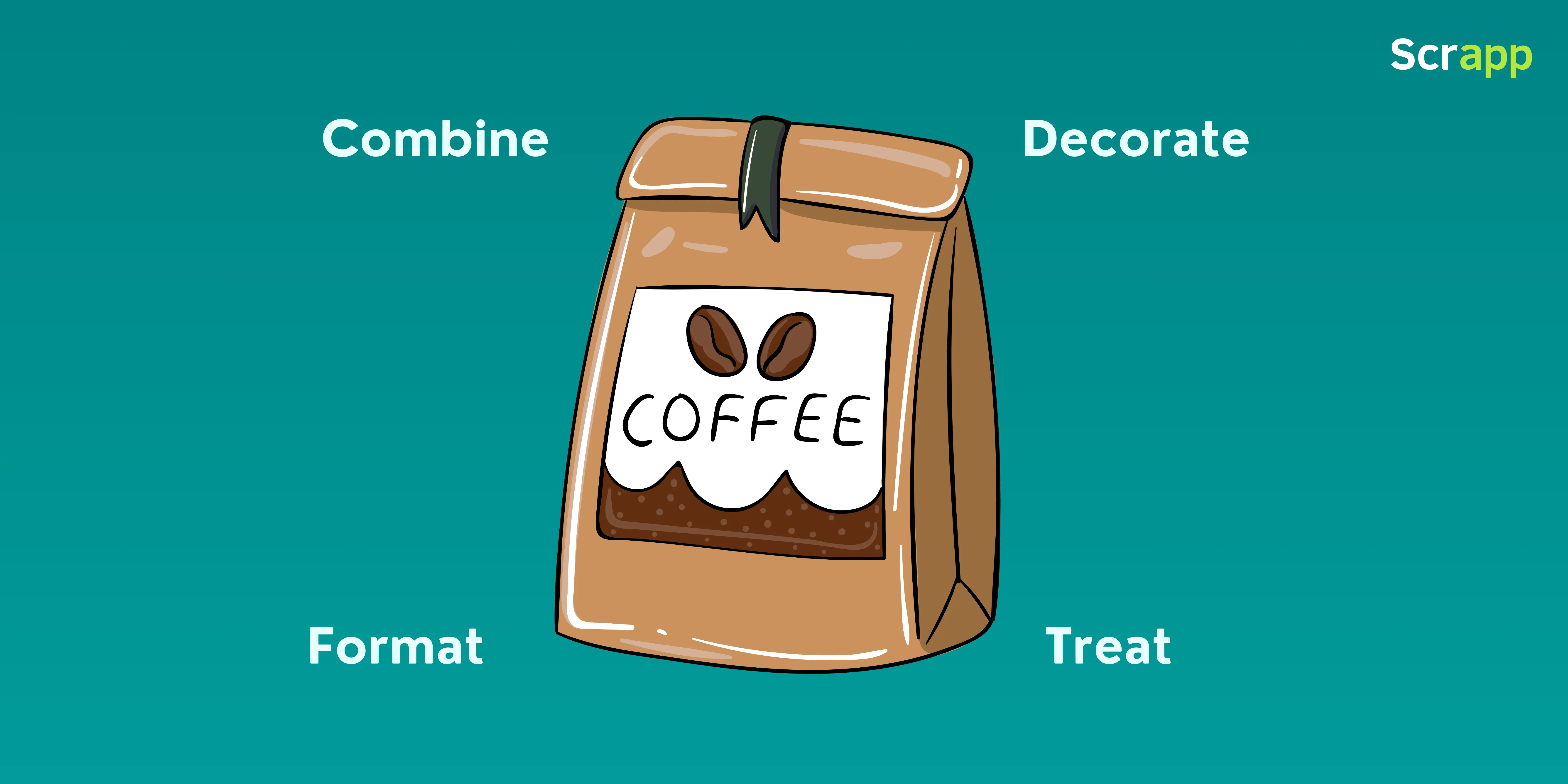
Each fails in one of four ways: the item can't be sorted, can't be separated, contaminates the output, or has no end market. Crucially, every lever also runs in reverse — the craft of design-for-recovery is mostly the discipline of choosing the better setting.
Plastics: the richest set of decisions
Plastics carry the most behind-the-label decisions because their entire recycling system runs on resin purity.
Combine — the laminate is the single biggest killer. Bonding different polymer families into one film delivers performance no single material offers, and creates a structure recycling cannot process. Most multi-material flexible packaging is landfilled, whatever the front suggests. The better setting: mono-material structures built from one family — an all-PE or all-PP pouch — that drop cleanly into a single stream.
Decorate — most black plastic uses carbon black, which absorbs the near-infrared light material recovery facilities use to identify resins. To the sorter, it's invisible. This is a decoration choice, not a property of the plastic. Detectable black pigments that skip carbon black are beginning to scale.
Decorate and Format — a full-body shrink sleeve can defeat recovery two ways: it covers enough of the bottle that the sorter can't read the resin, and if the sleeve film is denser than water it sinks with the PET flake and contaminates the stream. The fix is well-documented: leave at least 20% of the bottle exposed, and use a polyolefin label that floats off cleanly.
Treat — barrier layers like EVOH don't separate in recycling. In small enough amounts, recyclers can tolerate them; past defined thresholds, they become contamination. Adhesives that don't release in the wash show up as haze in recovered resin. Wash-off adhesives that detach cleanly are now available and APR-recognised.
The throughline: anything that hides the resin, mixes resins, or fouls the melt defeats recovery — and a validated "better" already exists for each. Design-for-recovery in plastics is largely a solved problem at the spec level. It loses on cost, not feasibility.
Fiber: it's about what you add
Fiber is the most-recovered material by weight. The design lever that matters isn't whether fiber can be recycled — it's what you add to make it behave like plastic. A thin plastic lining on a hot cup keeps it from leaking but encapsulates the fibers, making them hard to separate. Water-based, repulpable barrier coatings are moving fast — more than 40 North American mills now take poly-coated cups — but most mills still aren't set up for them.
Metals: high recovery, ruined by gluing them to something else
Metals keep their properties through melting and can cycle effectively forever. The aluminum can recovers at roughly 43% in the US; in Europe, where separate collection runs deeper, aluminium packaging hits around 76%. When metal isn't recovered, it's rarely the metal's fault. It's usually a Combine decision — bonding aluminum to plastic or fiber, as in a foil-laminate pouch, making the aluminum as unrecoverable as the laminate around it. Keep it mono-metal and clean and it's one of the best recovery stories in the bin.
Glass: undone by its neighbors
Glass is chemically inert and can be remelted indefinitely. What kills glass recovery usually isn't the bottle — it's what gets collected with it. Ceramics and Pyrex look like container glass but melt at higher temperatures, causing defects. By a rule of thumb recyclers cite, one small ceramic piece can compromise around a ton of otherwise good cullet. Recoverability here is decided by stream design — what travels with the glass — far more than by the bottle itself.
The label, in its place
The number inside a triangle is a Resin Identification Code. It was never a recyclability claim. It tells a sorter which plastic they're handling — nothing more. The standards body deliberately swapped the old chasing-arrows for a plain solid triangle in 2013, precisely because people kept reading arrows as "recyclable."
Even the honest labels are conditional. How2Recycle uses four tiers — Widely Recyclable, Check Locally, Store Drop-off, Not Yet Recyclable — because recoverability is never a fixed property of an object. It's a property of the object, the place, and the system around it.
For brands, that conditionality is now a legal exposure. California's SB 343 prohibits recyclability claims on packaging made on or after October 4, 2026 unless the item clears a real-world bar: collected curbside for at least 60% of Californians and sorted by at least 60% of the state's programmes. You no longer get to call something recyclable because it theoretically could be. The claim on the front is only true if the design in back paid for it.
What's about to make it count
Three forces are turning design-for-recovery from a soft preference into a hard, priced constraint:
- Market access. The EU's PPWR grades every package A through E on recyclability. From 2030, anything below grade C can't be sold in the EU. From 2038 the floor rises to A or B.
- Fees. EPR programmes are live across seven US states. Several are eco-modulating fees — recoverable design pays less, hard-to-recycle design pays more, beginning in 2026.
- Liability. SB 343 turns an unearned recyclability claim into a false-advertising exposure from October 2026.
Design-for-recovery is no longer a sustainability line item competing with the business case. It is the business case. Every behind-the-label choice now has a number attached: a fee, a foreclosed market, a claim you can or can't defend.
The exposure you can't see
The decisions that determine all of this are distributed across a portfolio — hundreds of SKUs, each with its own combine/decorate/treat/format profile — and most brands can't see the exposure, because nobody has mapped their material composition against where recovery succeeds or fails.
That's the gap Scrapp works in: turning a portfolio's material flows into a clear view of where recoverability — and the cost now attached to it — actually sits, so expensive choices get caught at the design table instead of at the fee invoice.