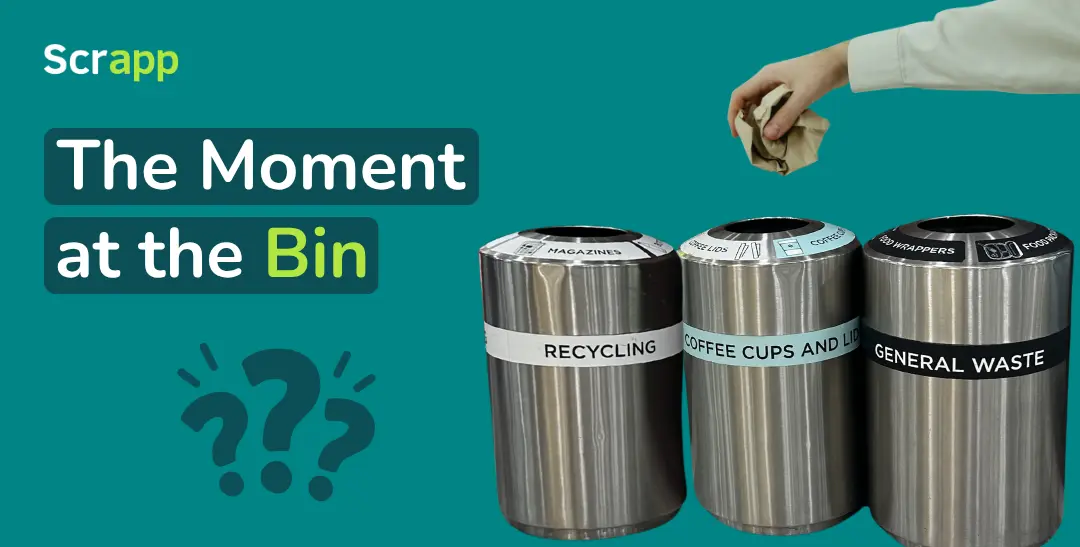
Someone is standing at a bin right now with an empty cup in their hand.
They have just finished a drink. They are mid-conversation, or reading a sign, or waiting for their ride. In front of them are two openings, maybe three: trash, recycling, and if they are lucky a label with a faded picture of a bottle on it. They glance down. A flicker of a question crosses their mind — "is this one recyclable?" — and before they have really answered it, their hand has already moved. The cup is gone. They are already thinking about something else.
That single decision, repeated millions of times a day across a city, is the moment every recycling programme ultimately runs on. It is also the moment we understand the least.
This is a piece about what is actually happening in that decision, and why it produces the contamination rate that shows up later in a municipal budget. It is a diagnosis, not a list of fixes.
Where does everything upstream end up?
For four weeks we have worked upstream — how disposability was engineered into the system, the industry that disposal built, where materials come from, and the design decisions that quietly decide a package's recyclability before anyone buys it. The material sets a ceiling. The design decides whether you ever reach it.
And then all of it arrives here, at a bin, in the hands of a person who had no part in any of those decisions and has about as long as it takes to read this sentence to get the call right.
Here is the uncomfortable, useful claim of this piece: the disposal decision is not a considered judgment that occasionally goes wrong. It is a fast, low-attention guess made under genuine uncertainty, with no feedback to correct it. When you understand it that way, contamination stops looking like a failure of character and starts looking like the predictable output of the moment as it is currently built. The resident is not the bug. The moment is.
That reframe matters most to the person who owns the consequence: the municipal recycling coordinator, whose contamination rate is not an abstraction but a line in a budget, a chargeback from a sorting facility, and a question from a council member.
How does the disposal decision actually get made?
Behavioural scientists describe two broad modes of thinking. One is fast and automatic: you recognise a face, you catch a dropped glass, you sort a familiar object into a familiar slot. The other is slow and deliberate: you compare two mortgage offers, you work through a tax form. The disposal decision behaves like the first kind — and the evidence for that is unusually clean.
In a controlled experiment staged as a yogurt taste test, researchers watched 399 people throw away a used cup. The single best predictor of which bin they used was not their stated commitment to recycling — it was where the bins were standing. Physical position explained more than half the variation in which bin people chose, while self-reported recycling intentions were essentially unrelated to what they actually did (Rosenthal and Linder, 2021). People were not consulting their values. They were responding to the layout of the room.
The decision also runs on appearance rather than analysis. Consumers were more likely to throw a recyclable item in the trash when its shape had been distorted — a crumpled piece of paper versus a flat one — because it no longer matched the mental picture of "a recyclable thing" (Trudel and Argo, 2013). The actual recyclability of the object barely enters into it.
The disposal call is not thought through and then executed. It is pattern-matched and resolved, usually before the slower, deliberate system has a chance to weigh in.
What is the disposal decision actually working with?
Here is what the fast system is working with: very little, and much of it misleading.
There is no national recycling standard in the United States. What is accepted depends on the local facility and the contracts behind it, varying town to town. The Recycling Partnership has found that only about one in four residents recall any communication from their recycling programme in the past year (The Recycling Partnership, 2022). The person at the bin is frequently guessing about rules they were never clearly told.
Then there is the most actively misleading signal in the whole system: the chasing-arrows symbol with a number inside it. Most people read that as "this is recyclable." It is not what the symbol means. The resin identification code indicates which type of plastic an item is made from, not whether it can be recycled where you live. In practice, only resins 1 and 2 have reliable end markets in most places (Kramer and Yoeli, 2023). The symbol that looks like a recycling instruction is actually a manufacturing label.
Now add the part that makes all of it worse: there is no feedback. The person who recycled that cup will never find out whether they were right. In almost every other skill a person develops, they learn because reality answers them. At the bin, reality says nothing. The correct behaviour is never reinforced and the incorrect behaviour is never flagged, so neither one ever improves.
Put those together — ambiguous items, hyper-local rules, a label that misleads, and zero feedback — and a lot of what gets counted as contamination is not "I didn't think." It is "I genuinely couldn't tell."
What is wish-cycling — and why does caring make it worse?
When a person who cares is genuinely unsure whether something is recyclable, they tend to put it in the recycling anyway. There is a name for this: wish-cycling. It is placing a doubtful item in the recycling stream in the hope that it belongs there.
In a nationally representative U.S. survey, people said they would recycle 50.9% of items that are definitively not recyclable, and 60.6% of items that are genuinely ambiguous (Kramer and Yoeli, 2023). When in doubt, a great many people throw it in.
Here is the finding that should reframe how every programme talks about this. The people who wish-cycle the most are not the apathetic ones. The respondents who cared most about the environment were the worst over-recyclers (Kramer and Yoeli, 2023). Wish-cycling scales with caring, not with carelessness. The person putting the questionable yogurt cup in the recycling is not failing to try. They are trying hard, with bad information, and erring toward hope.
This is why framing wish-cycling as ignorance is both wrong and self-defeating. The honest description is gentler and more useful: wish-cycling is the rational output of caring under uncertainty with no feedback.
Why does caring about recycling not translate into recycling correctly?
Roughly eight in ten Americans say recycling is worth the effort or has a positive impact (The Recycling Partnership, 2022 and 2023). And yet, even where curbside access exists, roughly half of household recyclables still end up in the trash. The belief is nearly universal and the behaviour is nearly a coin flip.
The two-systems frame explains why. Stated values live in the slow, reflective system — when a survey asks "do you think recycling matters?", a person answers sincerely, yes. But the disposal decision is made by the fast, automatic system, in a few distracted seconds, responding to bin placement and item appearance. The value never makes it into the room where the decision happens. This is not hypocrisy. It is the predictable failure of a slow-system belief to govern a fast-system act.
For a recycling coordinator, this finding quietly undermines the default intervention. The instinct, when contamination is high, is to educate: send a mailer, run a campaign, raise awareness. But awareness is already high. People already believe. Raising stated intent that is already that high does little to move a behaviour that was never controlled by stated intent in the first place.
What does one distracted guess cost a municipality?
Millions of hopeful guesses, aggregated across every household in a jurisdiction, become a measurable inbound contamination rate. Reported residential contamination commonly runs 15% to 25%, and higher in some programmes — though the U.S. EPA has noted that the large majority of states do not even collect inbound contamination data (EPA, 2024–25), so treat the range as directional.
When a load arrives at a material recovery facility with too much contamination, the facility charges more to process it. As contamination has risen, facilities have moved from paying municipalities for recyclables to charging them. Contaminated loads carry the steepest fees; rejected loads get reclassified as trash and charged at disposal rates plus a rejected-load fee. At the system level, contamination is estimated to add at least $300 million a year in added U.S. recycling costs through extra labour, equipment damage, downtime, and lost commodity value.
And as packaging EPR laws take effect across a growing list of states, the contamination rate is increasingly tied to formal performance standards that determine what a municipality can recover from producer responsibility organisations. The contamination rate is becoming not just an operating cost but a compliance metric. For research on how leading programmes are managing contamination and its costs, browse our reports library.
Why is contamination structural, not behavioural?
The disposal decision resolves into four forces acting on one person in one moment.
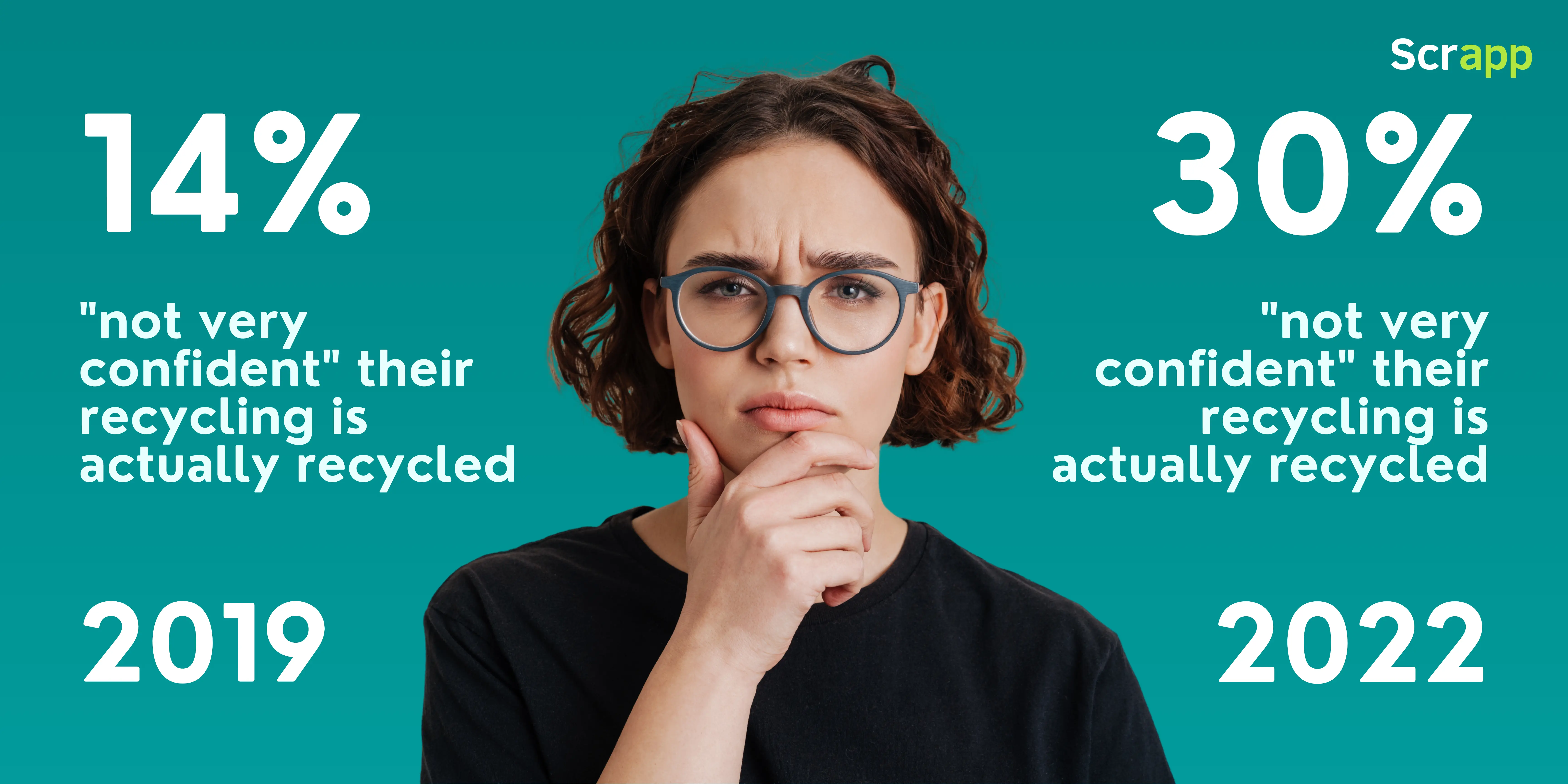
There is attention: the call gets almost no cognitive budget — it is a secondary task done while distracted. There is uncertainty: recyclability is genuinely ambiguous, rules are local and often uncommunicated, and the most prominent label misleads. There is feedback — or rather its absence: the person never learns whether they were right, so the decision never improves. And there is meaning: whether the person believes the effort is worth anything at all. The Recycling Partnership tracked people who are "not very confident" their recycling is actually recycled rising from 14% in 2019 to 30% by 2022 — and when someone half-suspects it all ends up in landfill anyway, the hopeful guess loses even its hope.
None of these forces acts alone. They stack. A low-attention call, made under real uncertainty, with no feedback, by someone unsure it matters — that is not a decision that occasionally fails. It is a decision engineered to fail.
Contamination is structural. It is the predictable output of a moment whose four conditions almost guarantee a wrong-but-well-meant answer. For the coordinator, that changes the question from "how do I get my residents to care more" — which they already do — to "how do I change the moment itself." That second question has real answers, with real evidence behind them, and they are exactly where we are going next.
Next in the series: What Actually Changes Behaviour — the interventions, what the evidence supports and what it does not, and the 80/20 of behaviour change at the bin.
Contamination is not a virtue problem. It is a budget line — chargebacks, rejected loads, and EPR compliance costs that trace back to a moment the programme was never designed to support. Scrapp® works with municipal waste coordinators to turn waste data into a clear picture of where the cost is coming from.