⚖️ What is a tipping fee? The cost behind your bill
.jpeg)
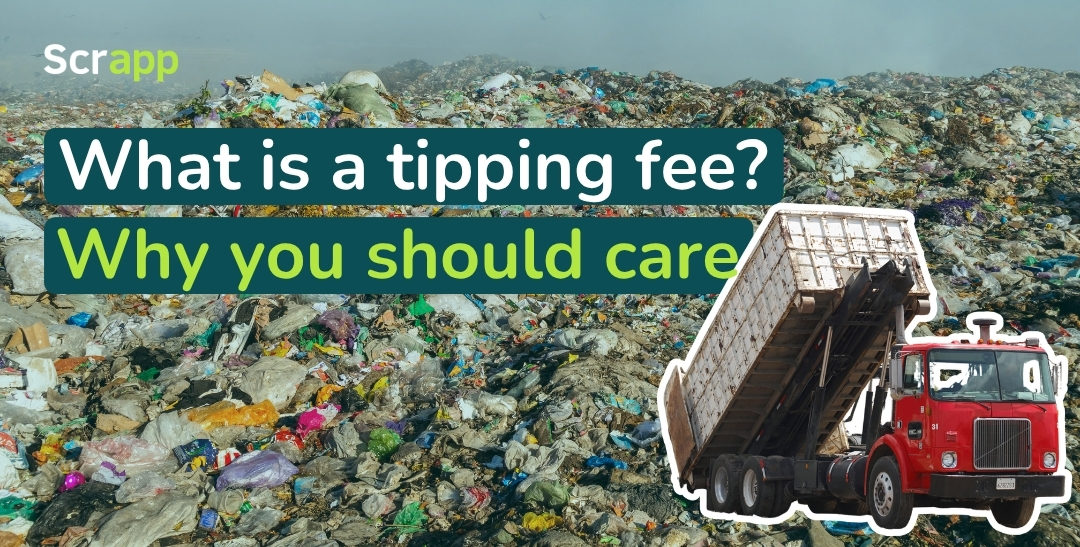
A tipping fee is the per-ton price a landfill or transfer station charges to accept waste. Your hauler pays it at the gate, then passes it through to you. The U.S. average hit $62.28 per ton in 2024 — a 10% jump in a single year, per EREF.
That number is the floor under your entire waste bill. Every ton you send to landfill costs you the gate price, plus the fuel, labor, and margin it takes to get there. When tipping fees climb, your invoice climbs with them — usually without a conversation.
Here's what the fee covers, why it varies so much, and what you can do about the part you control.
What does a tipping fee actually pay for?
The name comes from the act of tipping a load out of a truck. The fee covers the landfill's cost of taking that material and managing it for decades.
That includes the obvious things: labor at the gate, the machinery that spreads and compacts the load, the liner and cover systems. It also covers costs that outlast the site — leachate treatment, gas capture, and the 30 years of post-closure monitoring required after a landfill stops accepting waste.
Add state and local disposal taxes on top, and you have the gate price. It's charged by weight, which is why weight — not bin volume — is the unit that decides your cost.
Why are tipping fees rising?
Because landfill airspace is a finite asset, and it keeps getting harder to permit and build.
The Environmental Research and Education Foundation analyzed 351 landfills and put the 2024 national average at $62.28 per ton, up 10% year on year — the steepest rise since 2022. Large landfills charged over $70. The Pacific and Midwest saw the sharpest increases.
Two structural details matter for budgeting. Private landfills charge about 34% more than public ones, and states with waste-to-energy infrastructure run about 28% higher than states without it (EREF, 2024). Neither is something you negotiate, but both explain a gap you might otherwise blame on your hauler.
The direction of travel is what should shape your plan. A cost that rose 10% in a year isn't a fixed line item, and disposal pricing is the biggest reason your waste bills keep going up.
Why does the tipping fee vary so much by location?
Geography sets your price more than your negotiating skill does.
In the same 2024 EREF analysis, the Northeast averaged $80.67 per ton while the South Central states averaged $44.87. That's a spread of nearly 80% for the same act of disposal. Dense regions with scarce permitted airspace and long haul distances pay more. Regions with land and nearby capacity pay less.
This is why a single national average makes a poor benchmark. If you run multiple sites, expect your cost per ton to differ site by site, and expect the same tonnage reduction to save very different amounts at each one.
How does a tipping fee show up on your invoice?
Rarely as a line called "tipping fee."
Most haulers fold disposal into a bundled service charge, then add surcharges around it — fuel, environmental, administrative. The gate price sits inside that bundle, but the weight it was calculated from is often missing. That's the real problem: you can't verify a per-ton charge without the tons.
Ask three questions of any invoice. What weight was billed for each collection? What disposal rate per ton was applied? Which surcharges are calculated on that disposal cost, and at what percentage?
If your hauler can't answer in writing, you're being billed on numbers you can't check. We've broken down why a hauler's invoice reads like a black box and what to ask for instead.
How do you lower what you pay in tipping fees?
You can't set the gate price. You can change how many tons cross the gate. That's the whole lever, and it has three parts.
Know your weights. Start with a waste audit and waste characterization study to learn what's actually in your landfill bin. Most businesses find a large share of it is recyclable — tonnage they're paying the full gate price to bury.
Move tonnage to cheaper streams. Clean, separated recyclables cost less to handle than landfill waste, and sometimes earn a rebate. Every ton you move is a ton you stop paying the tipping fee on.
Right-size the service. Fewer half-empty pickups means fewer trips and less billed weight. Match container size and pickup frequency to how full your bins actually get.
Measurement is what makes all three work. One stadium using Scrapp® cut its waste bill by 22% by tracking weights by stream and acting on what the data showed. Scrapp customers commonly cut waste costs by up to 60% within 90 days.
Frequently asked questions
How much is a tipping fee per ton?
The U.S. average was $62.28 per ton in 2024, up 10% in a year, based on EREF's analysis of 351 landfills. Your rate depends on region and landfill type. The Northeast averaged $80.67 while South Central states averaged $44.87, and private landfills charge roughly 34% more than public ones.
Who pays the tipping fee?
Your hauler pays it at the landfill gate, then passes it to you inside your service charge. You rarely see it itemized, which is why asking for billed weights and the disposal rate per ton is the only way to check what you're actually paying for.
What's the difference between a tipping fee and a gate rate?
They usually mean the same thing: the per-ton price to dispose of waste at a facility. "Gate rate" is the term used at the site, and "tipping fee" is the term that follows the load through to your bill. Some facilities publish separate rates by material type.
Do recycling loads have tipping fees too?
Yes, though processing fees for clean recyclables are typically lower than landfill disposal, and clean material can earn a rebate. Contamination erases that advantage. If a load gets rejected, it's redirected to landfill and charged at the full disposal rate.
Does reducing waste actually lower this cost?
Yes, directly. Tipping fees are charged by weight, so every ton you divert is a ton you don't pay the gate price on. That saving compounds each year disposal pricing rises, which it has done every year since 2022.
Turn tonnage into a number you control
A tipping fee is the one waste cost set entirely outside your business. The tonnage crossing that gate is entirely inside it. That gap is where the savings live.
Want to know your real cost per ton and where it's leaking? Book a 15-minute call with the Scrapp team and we'll walk through your numbers together.