🔋 What battery fires reveal about recycling collection cost

Battery fires, EPR rules, and the real cost of collection
Lithium-ion batteries caused at least 448 fires at recycling and waste facilities across the US and Canada in 2025, according to fire-safety firm Fire Rover, and seven states passed new battery producer-responsibility laws in 2026 alone. For brand and retail sustainability teams, the two facts are connected. The cost of collecting hazardous material safely is moving off municipal budgets and onto the companies that put batteries into products in the first place, and it's moving fast.
What battery fires mean for brands facing new EPR rules
Battery fires are spiking at recycling and waste facilities. In June 2026, a garbage truck caught fire in Morrisville, North Carolina, after a single lithium-ion battery was crushed in the compactor with the rest of the load, according to WRAL. It wasn't a one-off. Fire Rover tracked 448 fires at recycling and waste facilities in the US and Canada in 2025, with more than $2.5 billion in damage, and the first two months of 2026 already produced 56 publicly reported fires, the highest February total since tracking began in 2016, per Resource Recycling. The industry now describes itself as operating in a permanently elevated fire-risk environment.
The fix: keep batteries out of the curbside cart. Lithium-ion batteries now ship inside phones, vapes, earbuds, power tools, and even novelty greeting cards. When one lands in a curbside cart and then gets punctured or crushed downstream, it can ignite the entire load around it, per EPA lithium-ion battery guidance. The practical rule for residents and employees alike: batteries don't go in the recycling cart or the trash cart. Tape the terminals and take them to a dedicated drop-off point instead.
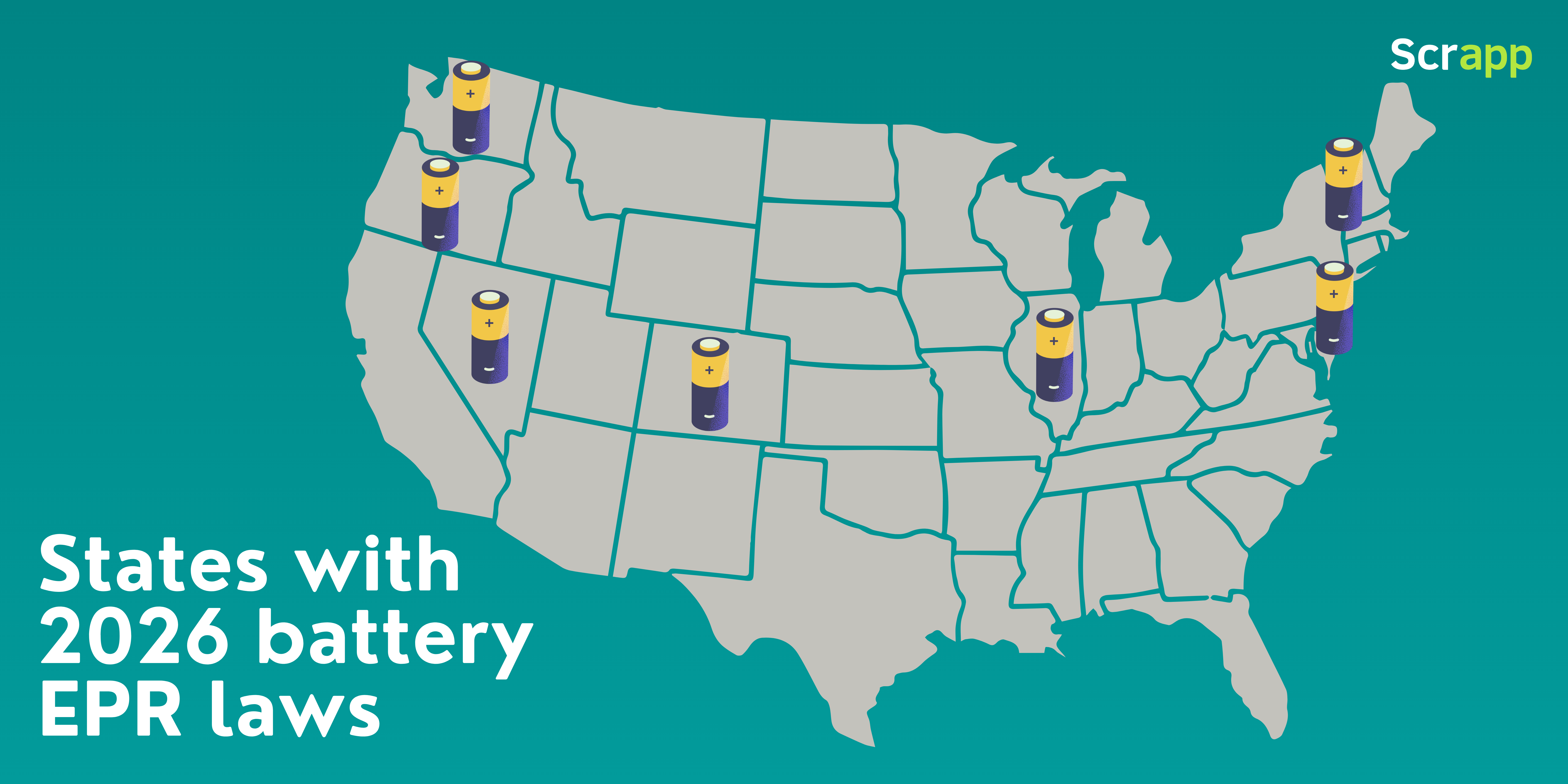
States are shifting battery costs onto producers. In 2026, Colorado, Oregon, Illinois, Nevada, New York, Vermont, and Washington all advanced battery or electronics producer-responsibility laws, based on Waste Dive's tracking. Illinois' portable-battery program (SB 3686) took effect January 1, and Vermont extended its existing law to cover rechargeables. The EPA is also expected to publish a voluntary national battery EPR and labeling framework this summer, backed by $15 million from Congress. Read that as a signal: if your company makes or sells anything with a battery inside it, the compliance clock has already started, and re-verifying each state's effective date before you act on it is worth the extra ten minutes.
How does recycling collection actually work, and why does it cost so much?
Battery fires are the sharpest recent example of a pattern that's been building in recycling for years: what happens at the curb determines what a brand pays later, whether that's an EPR fee, a contamination penalty passed through the supply chain, or a fire-damage claim. Four things explain why, and they're worth understanding together.
Single-stream collection, everything in one cart, is cheaper to run: one truck, simpler routes, less labor. But mixing materials raises contamination, and contamination raises processing costs while sending recoverable material to the landfill anyway. A study of 223 recycling systems in Ontario, published in the journal Resources (Lakhan, 2015), found single-stream programs achieved higher recycling rates but carried higher overall system costs than programs that kept streams separate. The cost the cart saves at the curb often gets spent again on the sort line, which is the same dynamic that lets a stray battery slip through undetected until it's already in a truck.
That sort-line cost isn't the biggest line item, though. In the EPA's 2024 Assessment of the U.S. Recycling System, curbside collection needed the largest share of investment to modernize US recycling, roughly half of the total, ahead of sorting and processing combined. Collection is the biggest cost center in the system, which means the decisions that matter most for cost and safety alike (what gets collected, how often, and how it's screened for hazards) happen before a single item reaches a facility.
Collection decisions don't happen in a vacuum either; the end market shapes them, and the relationship runs in both directions. In 2018, China's National Sword policy stopped accepting the contaminated mixed recycling the US had been exporting in large volumes, a shift documented in a 2022 Journal of Cleaner Production analysis of the US recycling transition. The response wasn't at the bin; it was on the sorting floor, where facilities slowed their lines and added staff to pull out contamination because clean material was the only kind buyers would still take. The lesson carries directly into packaging design: build for a buyer, or a compliance standard, that no longer exists, and you're left holding material, and liability, nobody wants.
Labor is the last piece, and it's changed faster than any of the others. Replacing a three-person collection crew with a one-person automated truck (the kind with an arm that grabs a standard cart) is reported to save roughly $80,000 to $130,000 per route per year and pay back the truck cost in two to four years, per industry and vendor analyses; these are directional estimates rather than a government-verified figure. One operator can now service 400 to 500 homes a shift versus 150 to 200 with a traditional crew. It's also why every cart looks the same: the arm needs a standard bin to grab, so the truck redesigned the cart, not the other way around.
What does this mean for brand and retail sustainability teams?
Every one of these forces (contamination costs, collection budgets, market signals, and automation) is now showing up as a line item in EPR fee schedules and battery compliance rules. Brands that can show accurate, location-specific data on what's actually in their packaging and products are better positioned to substantiate recyclability claims and respond quickly as more states finalize battery and packaging EPR programs. That's also the gap Scrapp® was built to close: fewer than 13% of businesses currently report clean waste data, according to industry research, which is exactly the kind of scattered spec data that makes state-by-state compliance harder than it needs to be. Scrapp's work on how contamination gets built into the system before a resident ever touches a bin and its breakdown of what actually decides whether packaging gets recovered both dig into the design decisions brands control long before a product reaches a compliance report. Scrapp's PVC recycling research for the Vinyl Institute is a useful reference for what that kind of producer-responsibility groundwork looks like in practice.
Frequently asked questions
What is extended producer responsibility (EPR) for batteries?
Battery EPR laws require companies that manufacture or sell battery-containing products to fund the safe collection and recycling of those batteries, shifting the cost away from municipalities. In 2026, Colorado, Oregon, Illinois, Nevada, New York, Vermont, and Washington all have active or newly effective battery or electronics EPR programs, per Waste Dive.
Which states passed battery EPR laws in 2026?
Seven states advanced battery or electronics producer-responsibility programs in 2026: Colorado, Oregon, Illinois, Nevada, New York, Vermont, and Washington. Illinois' portable-battery law (SB 3686) took effect January 1, and Vermont extended its program to cover rechargeable batteries.
Why do batteries cause fires at recycling facilities?
Lithium-ion batteries ignite when punctured or crushed, which happens routinely when they're placed in curbside recycling or trash instead of a dedicated drop-off point. Fire Rover recorded 448 recycling and waste facility fires in the US and Canada in 2025, with more than $2.5 billion in damage.
Why does collection cost matter to a brand, not just a municipality?
Collection is typically the largest cost center in a recycling system, per the EPA's 2024 assessment, and that cost increasingly shows up in EPR fee structures, contamination penalties, and compliance obligations tied to how a product or its packaging is actually collected and sorted, not just how it's labeled.
Do batteries belong in curbside recycling or trash?
No. Batteries should never go in a curbside recycling or trash cart. Tape the terminals on loose batteries and take them to a hardware store drop-off, an e-waste collection event, or a municipal battery collection point instead.
Brands that want a clearer picture of how their packaging and battery-containing products move through the collection and recycling system, before the next EPR fee schedule lands, can book a 30-minute compliance review with Scrapp.