.webp)
From free recycling apps with barcode scanning to AI-powered zero-waste platforms for municipalities, universities, and households — here’s app worth downloading this year, with a full feature comparison.
In This Article
- Why You Need a Recycling App in 2026
- The Top 10 Recycling Apps of 2026
- Feature Comparison Table
- How to Choose the Right App for You
- The Verdict
Why You Need a Recycling App in 2026
Recycling rules are more confusing than ever. With Extended Producer Responsibility (EPR) legislation rolling out across Europe and North America, new material bans in various states, and the persistent problem that 40% of on-pack disposal labels are incorrect, consumers and organizations alike need better tools to recycle right.
The core issue? Recyclability isn’t universal. A PET bottle that’s recyclable in Miami might not be in a rural Montana county. A yogurt pot accepted in one London borough could be rejected in the next. This location-specific complexity is exactly what recycling apps are designed to solve — and in 2026, the market has matured significantly.
Whether you’re a resident looking for a free recycling app with barcode scanning, a municipality seeking to engage citizens and cut call-center volumes, or a university sustainability coordinator aiming for zero-waste certification, this guide breaks down the 10 best options available on iOS, Android, and web.
Quick context: Recycling apps generally fall into three categories — educational tools (teaching you what goes where), rewards-based apps (incentivizing recycling behavior), and operational platforms (helping organizations manage waste programs). Most of the apps below span multiple categories. For more on these distinctions, see Scrapp’s 2025 recycling app comparison and our roundup of the best sustainability apps for businesses in 2024 to see how the rankings have changed.
The Top 10 Recycling Apps of 2026
1. Scrapp
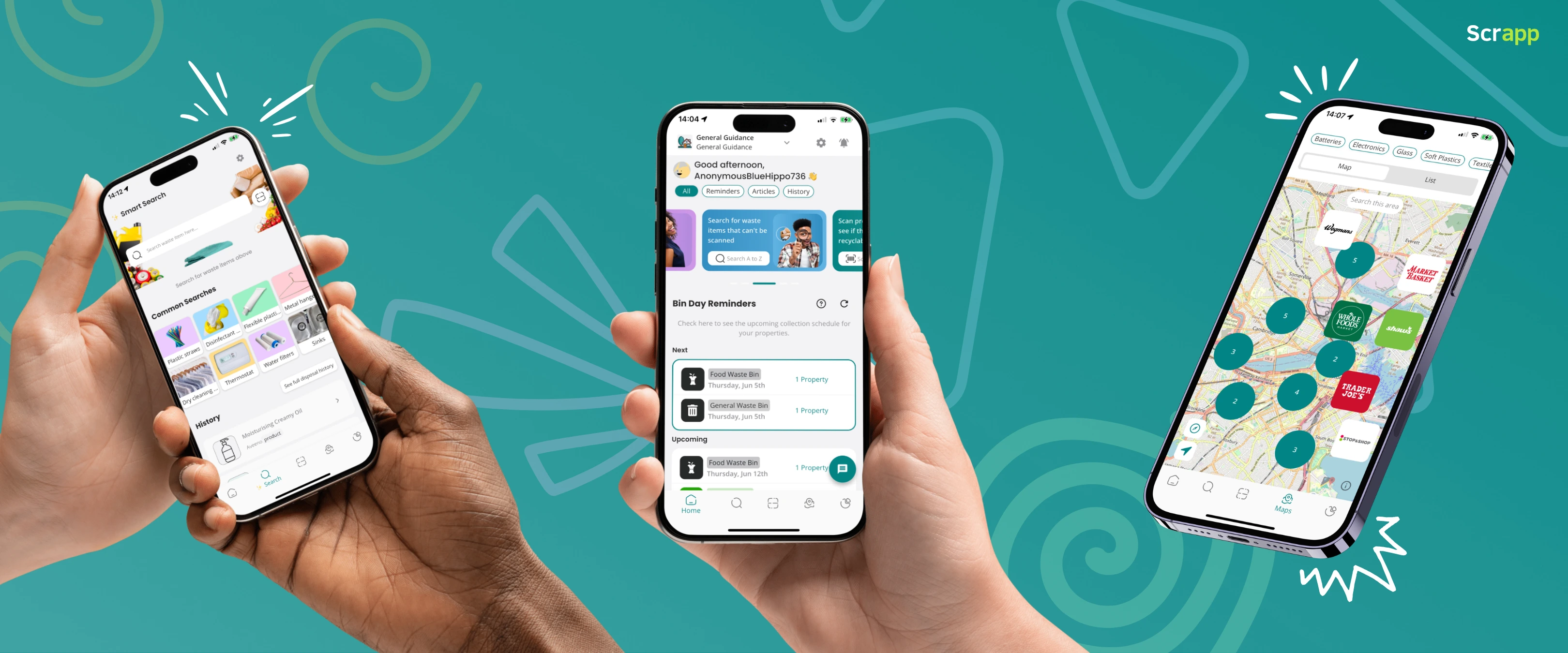
The free recycling app that works for everyone — from your kitchen to your city council
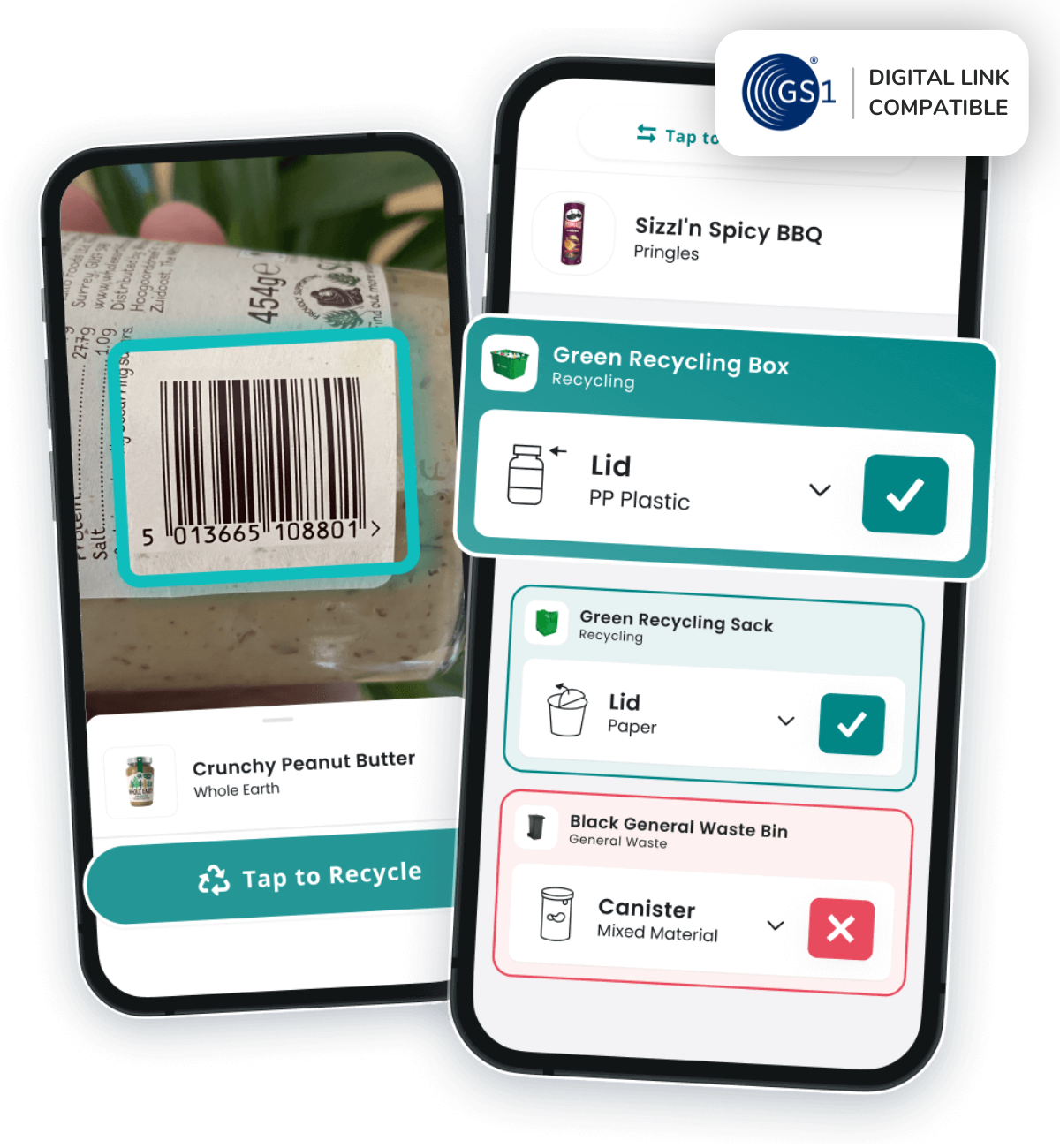
Scrapp functions as a comprehensive recycling encyclopedia in your pocket. Users scan barcodes or use the AI-powered SmartSearch to get instant, location-specific disposal guidance. What sets it apart from every other app on this list is that it serves the entire waste ecosystem simultaneously: consumers, municipalities, universities, businesses, and brands & retailers — all through a single interconnected platform.
The consumer app (100% free on iOS, Android, & web) includes bin day reminders, push notifications, collection point maps, gamification features, and environmental impact tracking. The app is available in 21 languages and is WCAG 2.2 AA compliant, making it the most accessible recycling app on the market for non-native speakers, visually impaired users, and people with disabilities. For every in-app scan, Scrapp removes one ocean-bound plastic bottle through its partnership with Plastic Bank. The behavioral science-backed UI, informed by B.J. Fogg’s research, is designed for long-term habit formation rather than short-term engagement spikes.
On the organizational side, Scrapp provides a co-branded web portal where municipalities and universities can manage their waste programs, track resident engagement in real time, customize guidance colors and branding, publish custom articles, and send targeted push notifications. The platform’s embeddable widgets allow partners to drop Scrapp’s search, maps, and gamification tools onto their existing websites with a single line of HTML code. The results speak for themselves: in the UK, the Re3 partnership (serving Reading, Wokingham, and Bracknell Forest) used Scrapp to save over 1,000 hours of annual query handling time and cut printed material costs while engaging over 500,000 residents.
For brands and retailers, Scrapp’s software optimizes products for end-market recyclability, forecasts EPR costs state-by-state or country-by-country, and provides waste reduction insights at the barcode and SKU level. The free consumer app effectively doubles as a data collection layer that shows brands where their packaging is confusing customers — a powerful incentive for designing for a zero-waste product line.
Cost: Free for consumers
Platforms: iOS, Android, Web
Markets served: 🇬🇧 🇺🇸 🇨🇦
Languages: 21
Best for: Everyone — consumers, municipalities, universities, brands
Key differentiator: Location-specific AI guidance + multi-stakeholder platform + 21 languages + WCAG AA accessible
Related reading: What does zero waste mean? · The 3 golden rules of recycling · 11 best practices for a recycling program · Re3 case study
2. Recycle Coach
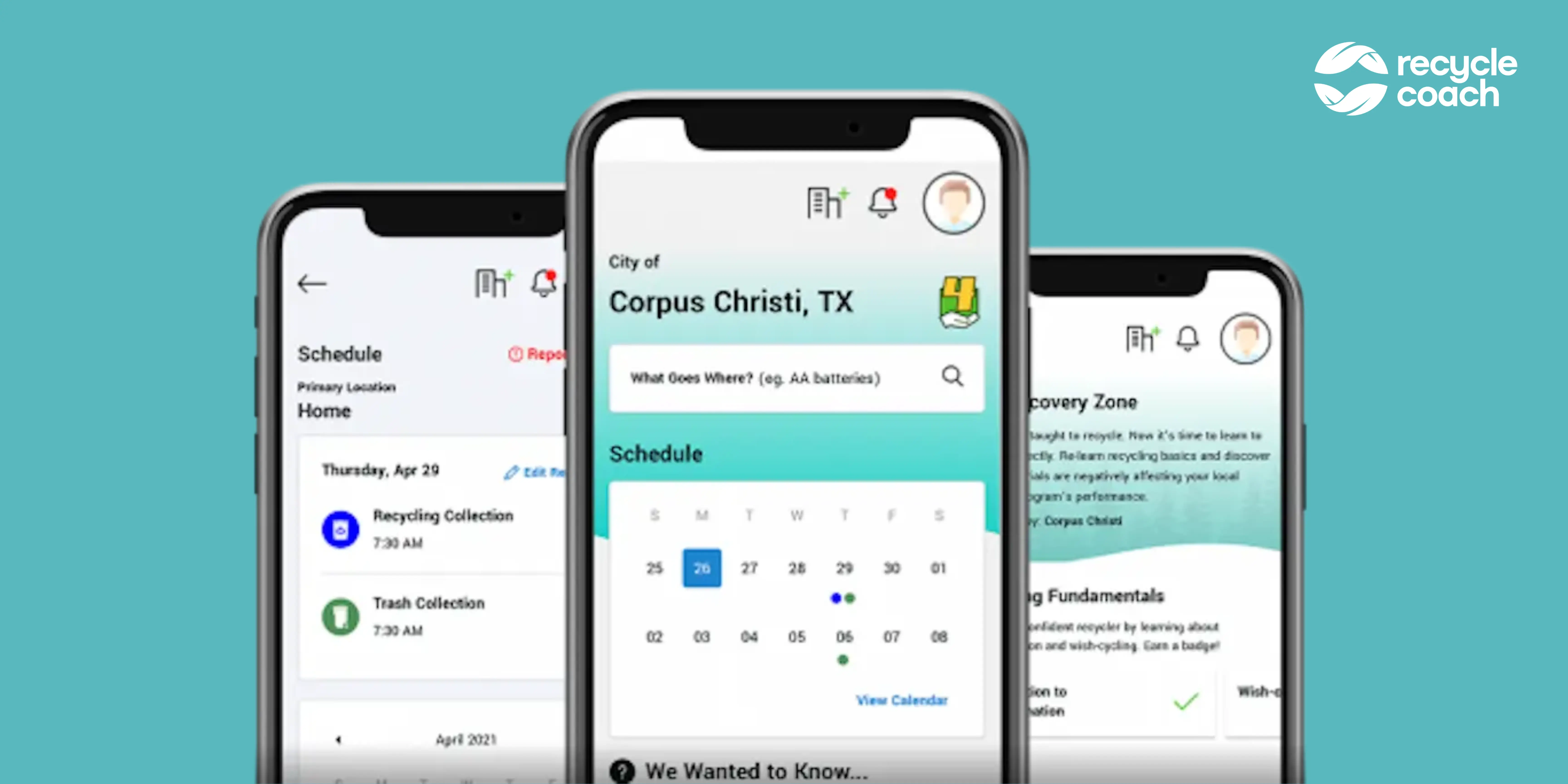
Your local government’s digital recycling assistant
Recycle Coach acts as a municipal waste communication tool, providing residents with collection schedules, reminders, a “What Goes Where?” search tool, and educational content tailored to their specific local authority. It also features an image recognition tool that lets users take photos to identify items. The app is widely adopted across North American municipalities and serves as a white-label solution that councils can deploy under their own branding.
The strength here is schedule management — if your primary need is remembering which bin goes out on which day, Recycle Coach handles that well. The limitation is that it’s largely a North American solution, the material database relies on municipal partnerships rather than independent barcode-level data, and it doesn’t serve brands or businesses. The app is available in English only.
Cost: Free for residents
Platforms: iOS, Android, Web
Markets served: 🇺🇸 🇨🇦
Best for: North American residents wanting schedule reminders
Key differentiator: Deep municipal collection schedule integration
3. Bower (Plovie)
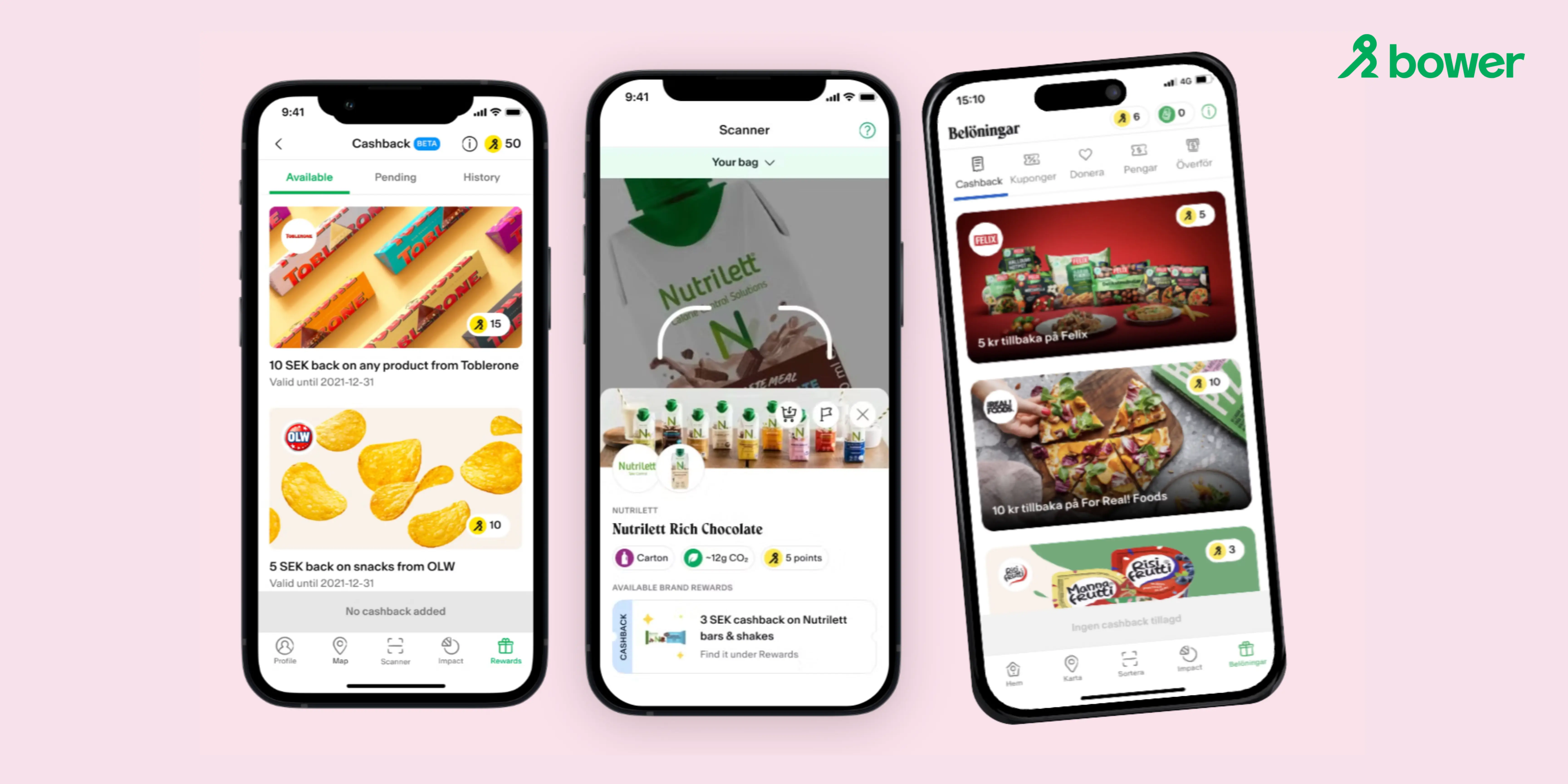
Gamified recycling with real cash rewards
Bower — recently rebranded to Plovie in the UK — turns recycling into a game where users earn coins for correct disposal that can be converted to cash, coupons, or charitable donations. With over 700,000 users globally, it has the largest consumer user base of any rewards-focused recycling app. Users scan barcodes or use image recognition, locate nearby recycling points, and complete challenges to earn rewards.
Bower’s strength is engagement through financial incentives. The lottery feature (where scans generate prize draw tickets) adds another motivation layer. However, the rewards model requires sharing purchase and behavioral data with brand partners, and some users report inconsistencies with balance tracking. The app’s focus is squarely B2C — it doesn’t offer tools for municipalities or businesses to manage their waste programs. The app interface adapts to device language settings but is primarily available in English and Nordic languages.
Cost: Free
Platforms: iOS, Android
Markets served: 🇸🇪 🇳🇴 🇩🇰 🇫🇮 🇬🇧 🇺🇸 (pilot)
Best for: Individual consumers wanting financial incentives to recycle
Key differentiator: Cash/coupon rewards for recycling + brand partnerships
4. ReCollect (by Routeware)
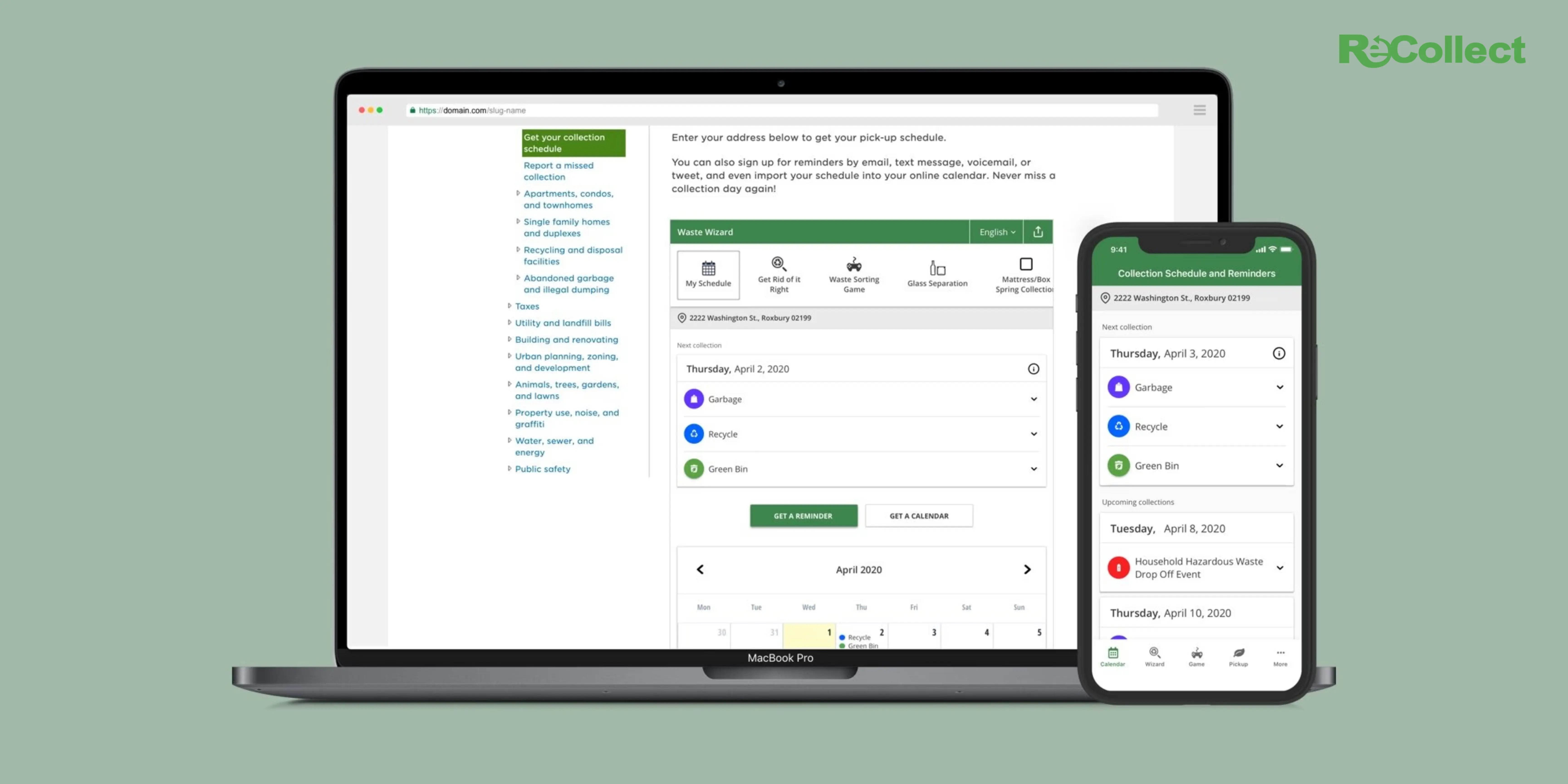
The infrastructure behind many municipal recycling apps
ReCollect operates as a B2B platform that municipalities use to create their own branded waste management apps and digital communication tools. Now owned by Routeware, it serves municipalities, waste haulers, and universities across North America and Europe with schedule reminders, a “Waste Wizard” search tool, collection notifications, and embeddable website widgets.
ReCollect’s strength is proven scale — it has over 20 years of serving the waste industry and boasts partnerships with hundreds of local authorities. The limitation is that it’s primarily an infrastructure play; consumers don’t download “ReCollect” — they download their municipality’s branded app powered by ReCollect. It doesn’t offer barcode scanning, consumer gamification, or brand/retailer-facing tools. Language support depends on the deploying municipality.
Cost: Paid (municipalities)
Platforms: iOS, Android, Web widgets
Markets served: 🇺🇸 🇨🇦 🇬🇧
Best for: Municipalities needing white-label waste communication tools
Key differentiator: 20+ years of municipal waste infrastructure experience
5. ECGO
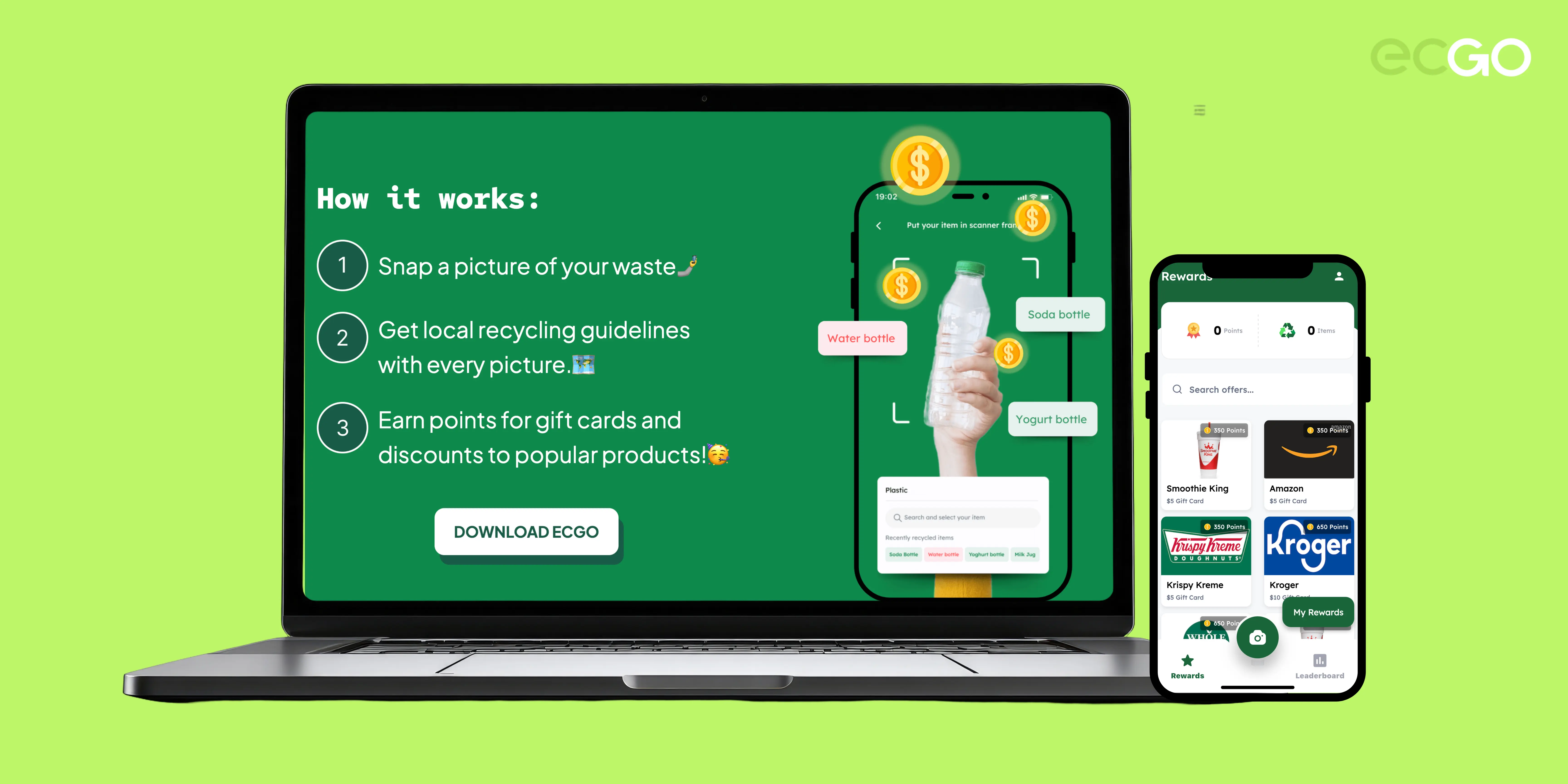
Rewards-based recycling built for university campuses
ECGO uses image recognition (snap a photo of any item) to provide location-specific recycling guidelines, paired with a rewards system where points can be redeemed for gift cards from brands like Amazon, Uber, and Publix. The app was purpose-built for universities, with campus-specific waste guidelines and a competitive leaderboard that pits recyclers against one another.
For sustainability coordinators at colleges, ECGO provides an admin portal with real-time waste stream insights and diversion tracking. The focus on higher education is both a strength (deep understanding of campus dynamics) and a limitation (less utility for general consumers or municipalities). The app is currently active at a small number of US universities including Georgia Tech and Georgia State. Some users have reported issues with submission approval delays and reliability. English only.
Cost: Free for students / Paid for institutions
Platforms: iOS, Android
Markets served: 🇺🇸
Best for: US university campuses
Key differentiator: Campus-specific guidelines + gift card rewards
6. Junker
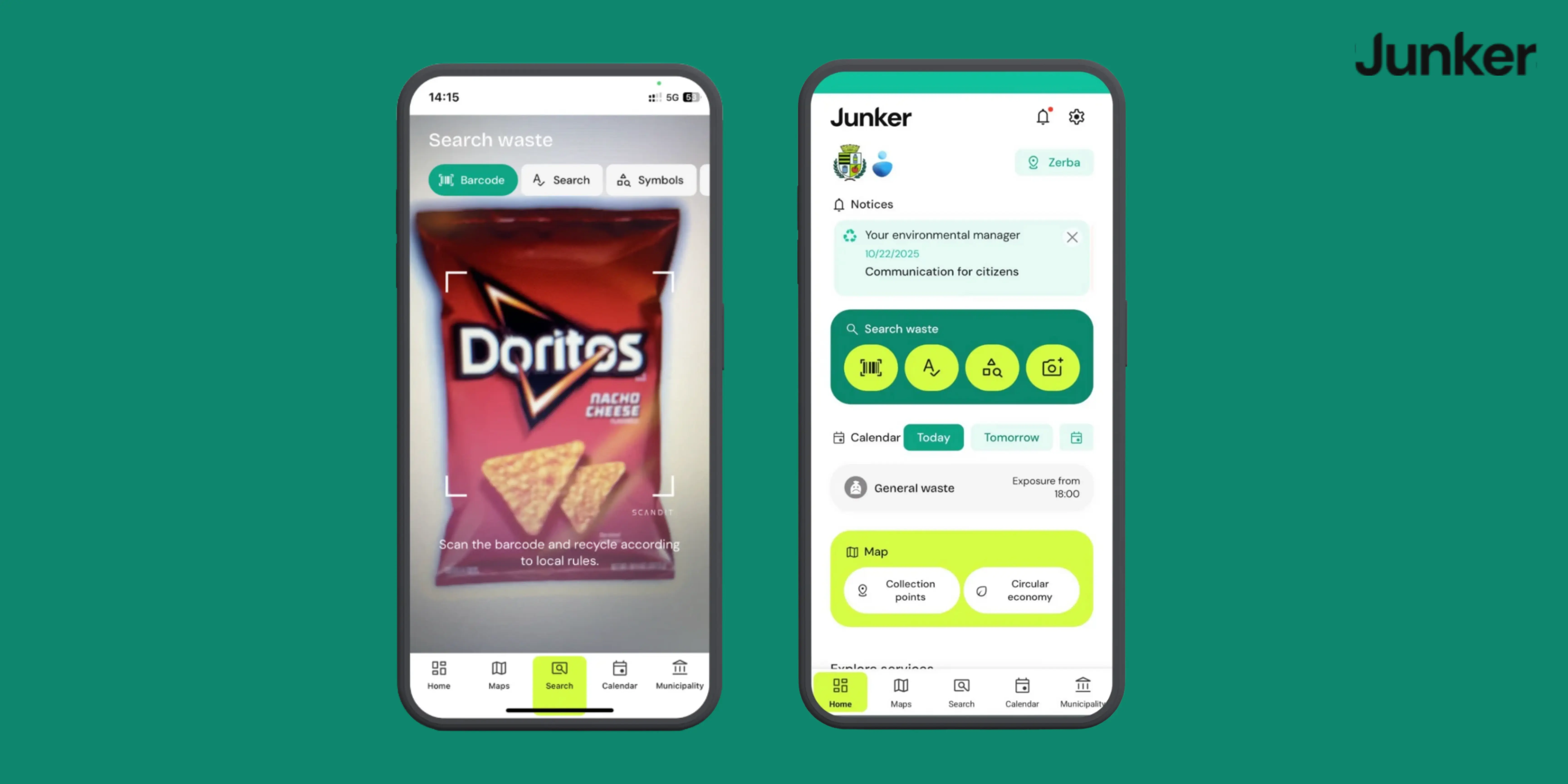
Italy’s dominant recycling app, now expanding across Europe
Junker is the most established recycling app in the Italian market, serving over 3,500 municipalities and approximately 30 million citizens. It recognizes over 2 million products via barcode scanning, photo recognition, or text search, and provides geolocation-based disposal instructions that update automatically as users travel between municipalities.
The latest version has evolved from a simple disposal lookup tool into a comprehensive municipal services platform — users can access collection calendars, book bulky waste pickups, report urban issues, access reuse center listings, and even manage waste tax payments. The app supports 14 languages and has been designed with strong accessibility features for visually impaired and elderly users, including TalkBack compatibility and sign language content. The main limitation is geographic: Junker is deeply embedded in Italy’s waste infrastructure but has very limited presence elsewhere.
Cost: Free for citizens
Platforms: iOS, Android
Markets served: 🇮🇹
Languages: 14
Best for: Italian residents and municipalities
Key differentiator: 2M+ product database + deep Italian municipal integration + 14 languages
7. Better Bin (Betterbin)
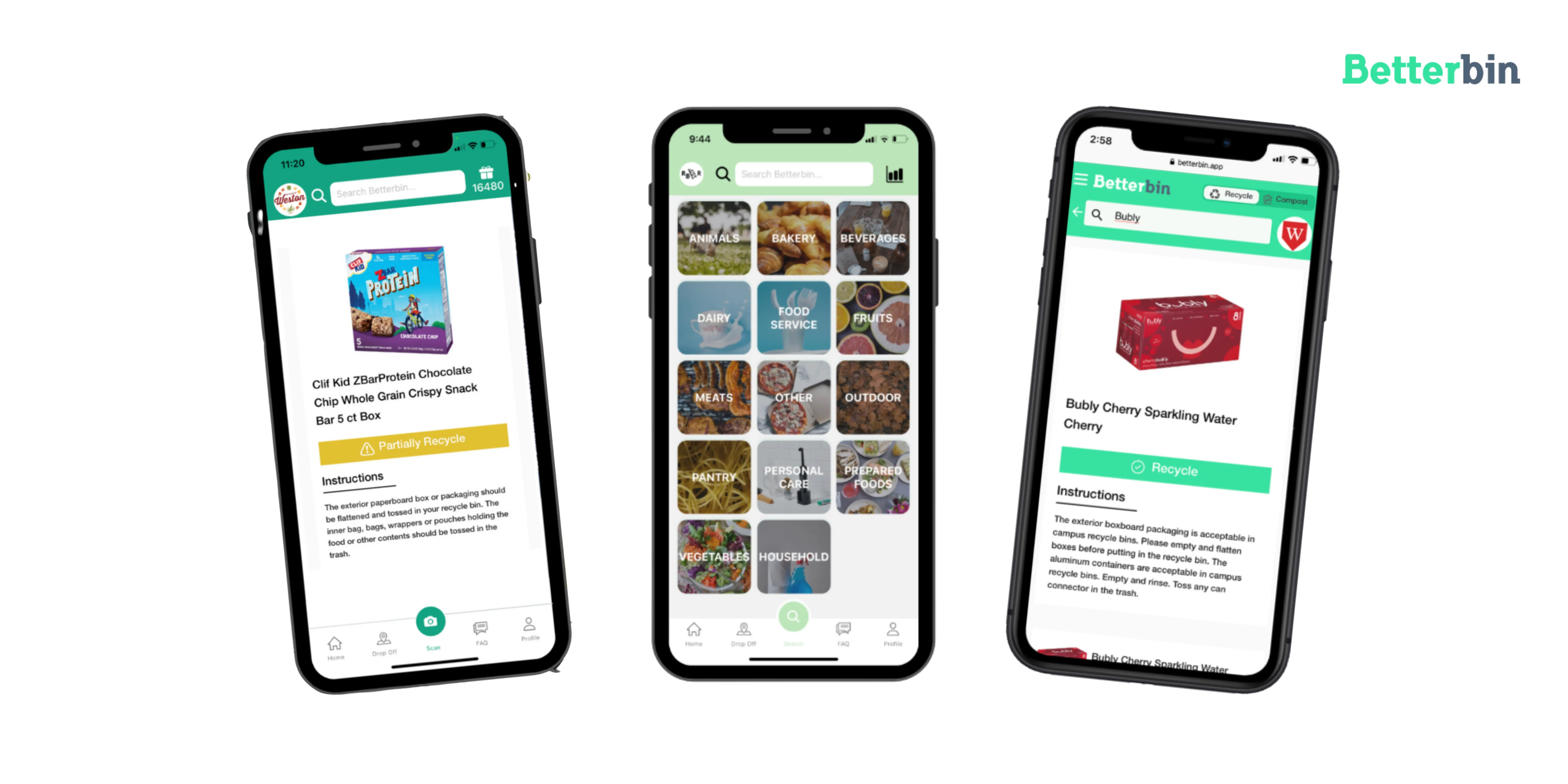
Hyper-local barcode scanning for community recycling and composting
Betterbin focuses on barcode scanning to deliver hyper-local recycling and composting instructions. The app lets users scan any product’s UPC code and receive disposal guidance specific to their community. A standout feature is its composting support — users in partner communities can look up whether “compostable” branded items are actually accepted in their local food waste program.
Betterbin partners directly with individual municipalities, waste facilities, and even subscription compost programs to deliver community-branded versions of the app. Users earn points redeemable for gift cards. The approach is bottom-up, partnering with individual towns (like Lebanon, NH and Hanover, NH) rather than large metros. The limitation is coverage — it serves a relatively small number of US communities compared to more established platforms. English only.
Cost: Free
Platforms: iOS, Android
Markets served: 🇺🇸
Best for: Small US communities with active composting programs
Key differentiator: Composting program support + UPC barcode scanning
8. Cloud 9 Technologies
Comprehensive citizen engagement for UK councils
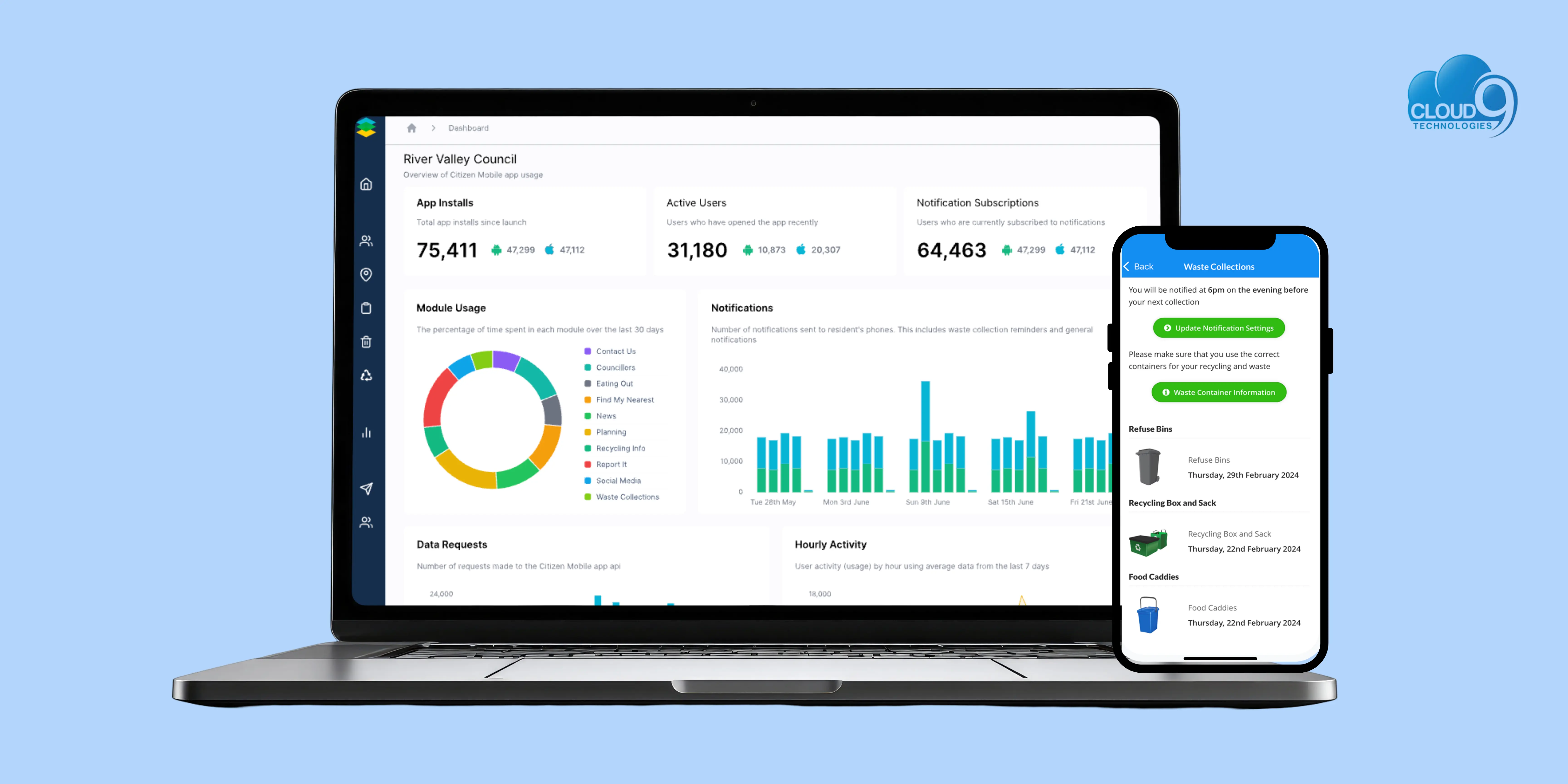
Cloud 9 provides a mobile app platform specifically built for UK local authorities. Their Citizen Mobile App includes bin collection calendars and reminders, searchable recycling information, push notification capabilities, a “Report-It” feature with mobile forms for fly-tipping and missed bins, and a “Find My Nearest” tool for council facilities.
The platform integrates with council back-office systems, making it a natural fit for local authorities that want a single app covering all citizen services — not just waste. Cloud 9 has positioned itself well around the UK’s Simpler Recycling initiative, helping councils proactively communicate collection changes and service disruptions. The limitation is that it’s exclusively a UK council solution with no consumer-facing product or international presence. English only.
Cost: Paid (councils)
Platforms: iOS, Android
Markets served: 🇬🇧
Best for: UK local authorities
Key differentiator: Full council citizen engagement platform beyond just waste
9. Whitespace Work Software
Operational waste management software for local authorities
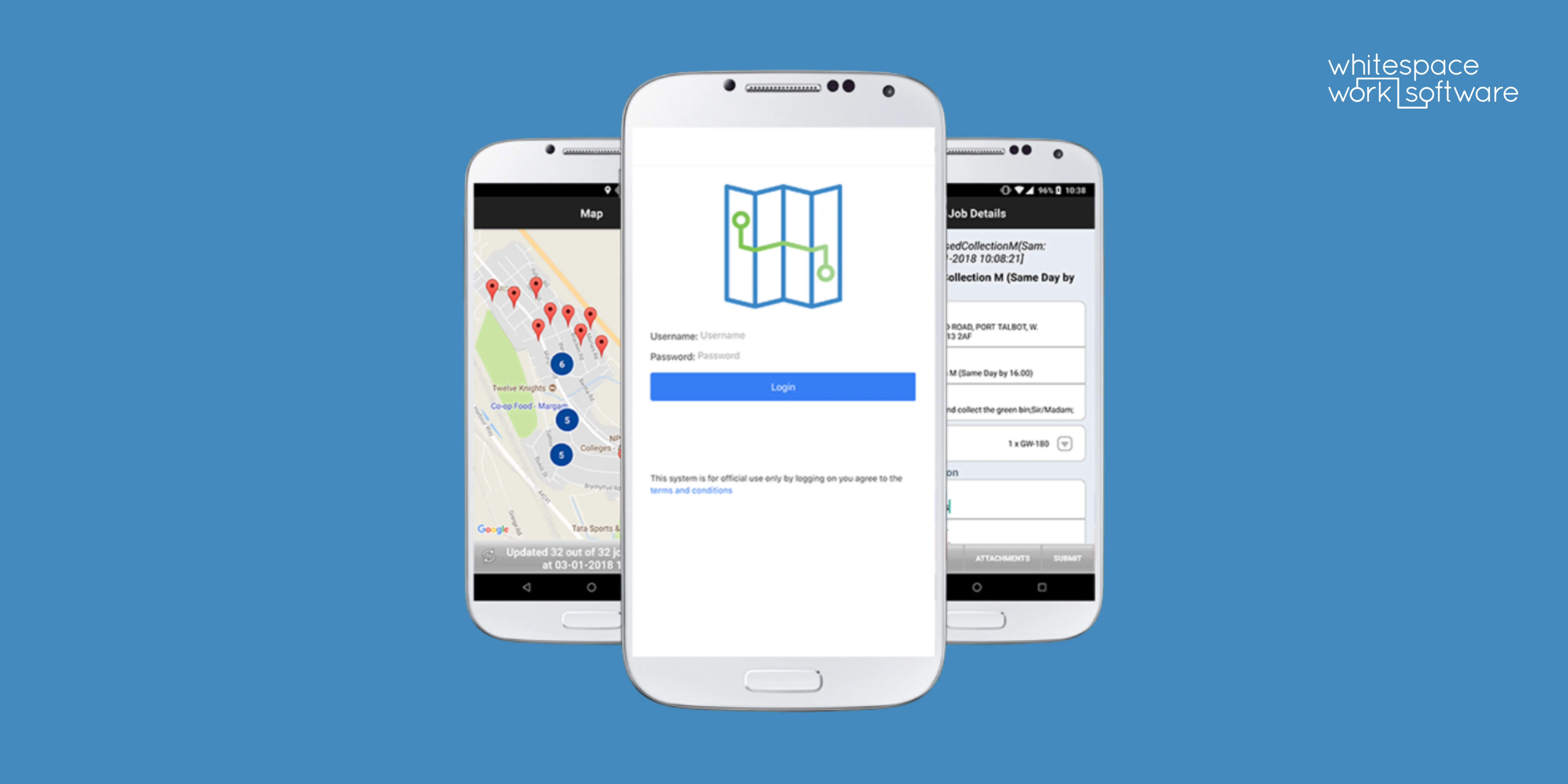
Whitespace sits on the operational side of waste management, providing in-cab mobile software for collection crews, back-office management tools, analytics dashboards, and a resident-facing mobile app. With over 100 UK council customers (representing roughly 32% market share), it’s the backbone of waste collection operations for a significant portion of the UK.
The Whitespace Resident Mobile App allows councils to communicate service updates, enable residents to check collection schedules, and report issues like fly-tipping and missed collections. While powerful operationally, Whitespace is not a consumer recycling education tool — there’s no barcode scanning, no product-level disposal guidance, and no gamification. It’s infrastructure for running waste services, not a tool for changing individual recycling behavior. English only.
Cost: Paid (councils/haulers)
Platforms: iOS, Android, Web
Markets served: 🇬🇧
Best for: UK councils needing operational waste management software
Key differentiator: End-to-end operational platform from collection to analytics
10. Earth911
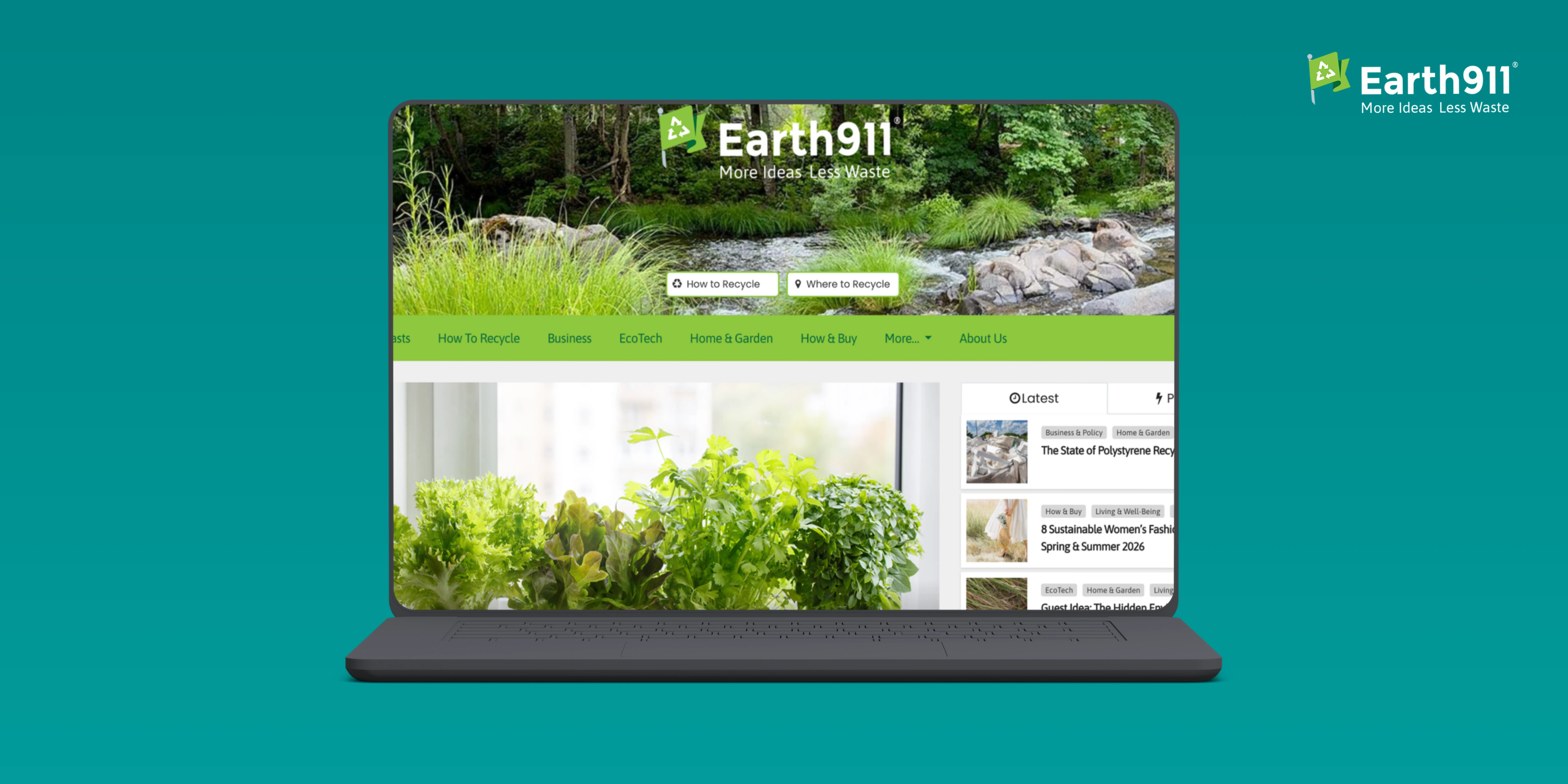
North America’s largest recycling database, available from any browserEarth911 isn’t an app — it’s a web-based recycling search engine that’s been running since the early 1990s, making it the longest-standing recycling resource in North America. Users enter a material (from common items like plastic bottles to niche categories like paint, vapes, or mercury-containing items) along with their zip code, and Earth911 returns a list of nearby drop-off locations and recycling centers that accept it.With over 350 material categories and 100,000+ facility listings, Earth911’s database is unmatched in breadth for hard-to-recycle items. It’s the go-to resource when you need to dispose of something unusual — old paint, CFL bulbs, medical sharps, tires — that curbside programs won’t accept. The site also publishes extensive recycling guides and educational content. The limitation is that it’s a search directory, not an interactive platform: there’s no barcode scanning, no personalization, no gamification, and no organizational tools. It’s web-only with no native mobile app (though the site is mobile-responsive). English only.
Cost: Free
Platforms: Web only (mobile-responsive)
Markets served: 🇺🇸 🇨🇦
Best for: US consumers looking up hard-to-recycle items
Key differentiator: 350+ material categories + 100K facility listings — the largest recycling directory in North America
Feature Comparison: How They Stack Up
The table below compares all 10 apps across the features that matter most for waste reduction — from individual recycling behavior to organizational program management.
How to Choose the Right Recycling App
The “best” recycling app depends entirely on who you are and what you need. Here’s a quick decision framework:
If you’re a consumer who wants a free recycling app with accurate, location-specific guidance and barcode scanning — Scrapp is the most comprehensive educational tool available on iOS, Android, & web. With 21 languages and WCAG AA accessibility, it’s also the most inclusive. If you want to earn cash for recycling and don’t mind sharing behavioral data, Bower/Plovie is a strong alternative.
If you’re a municipality looking to reduce call-center volume, engage residents, and drive waste reduction outcomes — Scrapp, Recycle Coach, and ReCollect all offer white-label solutions. Scrapp differentiates with its AI-powered search, multi-stakeholder ecosystem, and proven results like the Re3 partnership. In Italy specifically, Junker is the dominant choice. UK councils should evaluate Cloud 9 and Whitespace for operational needs.
If you’re a university aiming for zero-waste certification — ECGO was purpose-built for campuses, while Scrapp and ReCollect also serve higher education with more versatile platforms.
If you’re a brand or retailer navigating EPR compliance and wanting to understand how consumers interact with your packaging — Scrapp’s dual B2C/B2B model is uniquely positioned, as consumer scan data feeds directly into packaging optimization insights.
Key takeaway: Don’t just pick one app — layer them. A municipality might deploy Scrapp for resident education and Whitespace for operational collection management. A university might use ECGO for student engagement alongside Scrapp’s embeddable widgets on their sustainability webpage. The apps that serve the most use cases from a single platform, however, offer the simplest path to meaningful zero waste outcomes.
The Verdict
The recycling app landscape in 2026 has matured into a diverse ecosystem. Rewards apps like Bower drive short-term engagement. Municipal platforms like ReCollect and Cloud 9 solve operational challenges. And educational tools like Scrapp tackle the root cause: people simply don’t know how to recycle correctly in their specific location.
What makes Scrapp stand apart in this crowded field is its multi-stakeholder approach. By serving consumers, municipalities, universities, businesses, and brands through a single platform, it creates a virtuous data cycle: more consumer scans generate better packaging insights for brands, which drives better packaging design, which makes the app’s guidance more accurate — and so on. That flywheel, combined with the fact that the consumer app is completely free, available in 21 languages, WCAG AA compliant, and live on iOS, Android, & web, makes it the most complete waste reduction tool available today.
Whatever app you choose, the most important thing is to start. The best recycling app is the one you’ll actually use. Download one today, scan something in your kitchen, and see what you learn — the answer might surprise you.
Want to go deeper on recycling best practices? Read our guides on gamification strategies for recycling programs, 7 proven waste disposal communication strategies, designing for a zero-waste product line, and how to make an effective waste program.
Ready to Recycle Right?
Join thousands of people, municipalities, universities, and brands using Scrapp to make waste reduction simple, accurate, and data-driven.